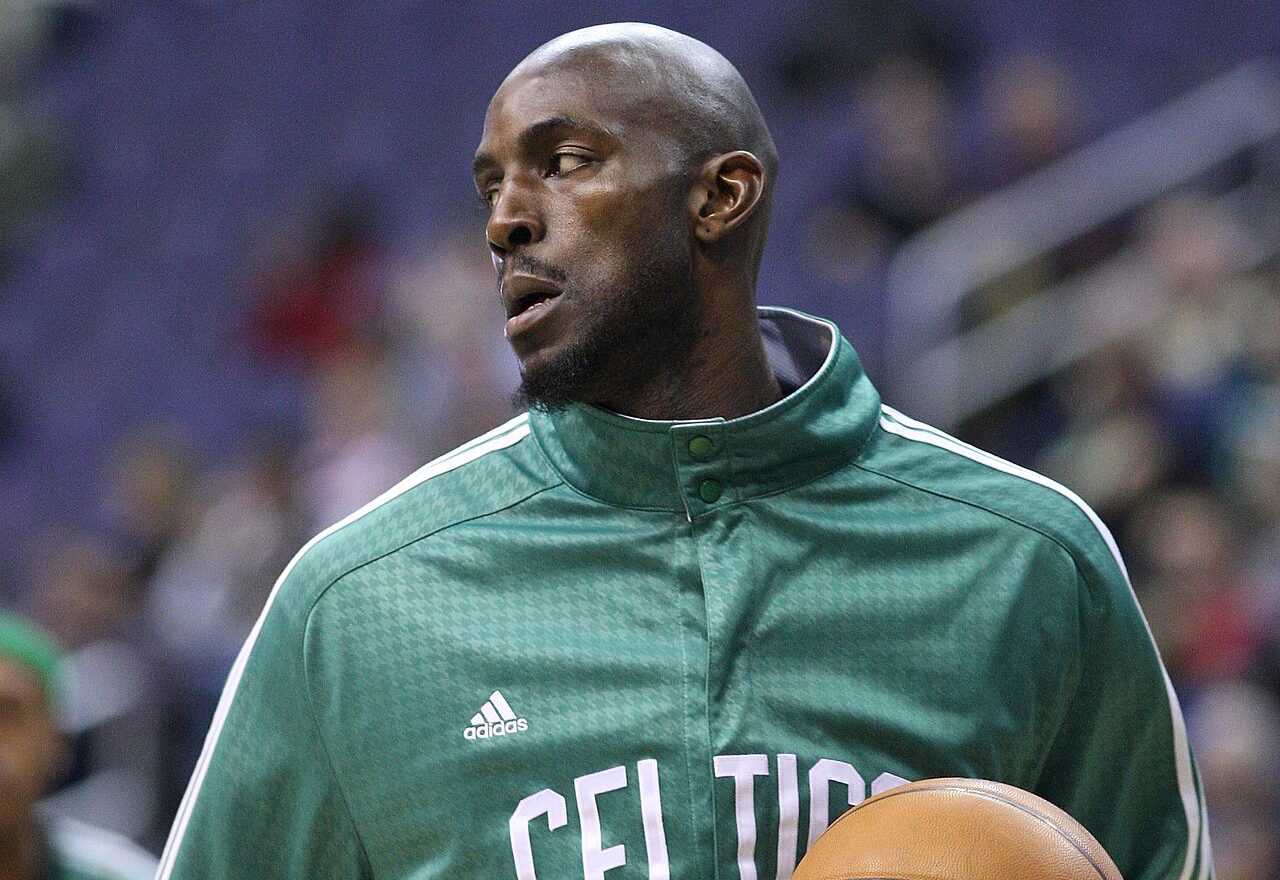
21 seasons, 15 All-Star selections, one MVP, one Defensive Player of the Year, and a championship that reshaped a storied franchise. Kevin Garnett’s résumé is easy to list. What made him different was harder to box up: a near-seven-footer who defended like a center, handled the ball like a wing, barked out coverages on every possession, and played every game as if it had already gotten personal.
From South Carolina to Chicago
Kevin Maurice Garnett was born on May 19, 1976, in Mauldin, South Carolina, near Greenville. He grew up in a close family with his mother, Shirley Garnett, and has two sisters, Sonya and Ashley. His father is O’Lewis McCullough. Basketball ran in the family too; his cousin Shammond Williams also reached the NBA.
As a teenager, Garnett attended Mauldin High School, where his talent was already obvious. He was long, quick, and unusually skilled for his size, but his path to the top was not smooth. Before his senior year, he was arrested after being present during a fight between Black and white students. He was charged with second-degree lynching under a South Carolina law then on the books, though Garnett maintained he was not involved in the assault itself, and the charge was later expunged.
That episode pushed him toward a fresh start. For his senior season, he transferred to Farragut Career Academy in Chicago, one of the country’s best-known basketball programs. There, the raw tools turned into national attention. Garnett was named the National High School Player of the Year by USA Today and quickly became one of the most closely watched prospects in the country.
The high-school leap that changed his life
In 1995, Garnett made a choice that still stands as one of the pivotal decisions of his era: he entered the NBA Draft straight out of high school. The Minnesota Timberwolves selected him with the No. 5 overall pick, making him the first player drafted directly from high school in two decades.
That alone made him a curiosity. What followed made him a blueprint.
Minnesota signed him in October 1995, and his rookie season showed both the challenge and the promise of the jump. He averaged 10.4 points, 6.3 rebounds and 1.8 assists, earned a spot on the NBA All-Rookie Second Team, and looked far more comfortable than most teenagers would have in a veteran league.
Even then, the outlines of the Kevin Garnett game were visible. He could grab a rebound, push the ball himself, hit a mid-range jumper, switch onto smaller players, and cover huge areas of the floor defensively. He was still growing into his body and his role, but the versatility was already there.
Kevin Garnett and the rise of the Timberwolves
By the late 1990s, the Timberwolves were no longer simply developing a prospect. They were building around a franchise player.
Garnett became the face of basketball in Minnesota, and for a long stretch he carried almost every part of the job. He scored, rebounded, initiated offense, defended the rim, switched onto guards, and supplied the emotional current of the team. The nicknames followed: KG, The Kid, and most famously, The Big Ticket.
His ascent came quickly. In 1997, he signed a six-year, $126 million extension, at the time the largest contract in professional sports. The deal became a major talking point around the league, but it also reflected what Minnesota believed it had: a rare star entering his prime.
From 1997 through 2004, the Timberwolves reached the playoffs every season. Garnett made his first All-Star team in 1997 and became a fixture there, eventually earning 15 selections. He made All-NBA First Team four times, All-Defensive First Team nine times, and established himself as one of the defining two-way players of his generation.
The peak came in 2003-04. Garnett averaged 24.2 points, 13.9 rebounds, 5.0 assists, 1.5 steals and 2.2 blocks, won the NBA MVP award, and led Minnesota to the Western Conference finals, still the deepest playoff run in franchise history. He also led the league in total rebounds that season and went on to lead the NBA in rebounds per game for four straight years, from 2003-04 through 2006-07.
Across his first stint with the Timberwolves, from 1995 to 2007, he played 927 regular-season games and averaged 20.5 points, 11.4 rebounds and 4.5 assists. Those numbers better capture his Minnesota years than the lower totals sometimes attached to his full two-part run with the franchise.
For all the individual honors, though, there was a limit to how far those Minnesota teams could go. Garnett kept producing. The roster around him rarely matched his level.
Boston gave him the stage he had been missing
The trade that changed the second half of his career came in the summer of 2007. Minnesota sent Garnett to the Boston Celtics, where he joined Paul Pierce and Ray Allen in a veteran core built to contend immediately.
His scoring numbers dipped in Boston, but that was the point. He no longer had to do everything. What he gave the Celtics was structure, defense, communication, and edge. He quarterbacked the back line, cleaned up mistakes, and set a tone that ran through the roster.
In his first season there, Boston won 66 games and the NBA title. Garnett was the defensive anchor of that team and won Defensive Player of the Year in 2007-08, adding that award to the MVP he had won in Minnesota. He remains one of the few players in league history to win both honors.
The Celtics reached the NBA Finals again in 2010, though they lost to the Los Angeles Lakers in seven games. Garnett was no longer the one-man engine he had been with the Timberwolves, but he was still central to winning basketball. In Boston, his intensity aged well because it was tied to habits as much as emotion: talking on defense, arriving early on rotations, contesting everything, demanding accountability.
He played 396 regular-season games for the Celtics and averaged 15.7 points, 8.3 rebounds and 2.7 assists. Boston later retired his No. 5 jersey, a fitting gesture for a player who spent only part of his career there but left a lasting mark on the franchise.
Brooklyn, then a return home
In 2013, Garnett was traded to the Brooklyn Nets as part of the blockbuster deal that also sent Pierce to Brooklyn. By then he was in the final stage of his career, and his role had narrowed. He was no longer asked to carry an offense or dominate games for long stretches. Instead, he gave the Nets rebounding, defense, and veteran presence.
He appeared in 96 games for Brooklyn and averaged 6.6 points and 6.7 rebounds.
Then came the full-circle ending. In 2015, the Nets traded him back to Minnesota. The return was more symbolic than statistical, but it mattered. Garnett was back with the franchise that had drafted him, and his presence offered a bridge between eras for a young Timberwolves team.
He played 43 games in that second Minnesota stint before retiring in September 2016.
The numbers that explain the player
Garnett finished his NBA career with averages of 17.8 points, 10.0 rebounds, 3.7 assists, 1.3 steals and 1.4 blocks per game over 1,462 regular-season games.
The most revealing stat line is not a per-game average but a combination of totals. He remains the only player in NBA history with at least 25,000 points, 10,000 rebounds, 5,000 assists, 1,500 steals and 1,500 blocks. That is the clearest shorthand for what he was: not just productive, but complete.
His honors continued after retirement. He was inducted into the Naismith Memorial Basketball Hall of Fame in 2020 and named to the NBA 75th Anniversary Team. Boston retired his No. 5 jersey in 2022.
One note needs care: Minnesota has not retired Garnett’s No. 21. The idea has been discussed for years, but any specific future date should be treated cautiously unless formally announced by the team.
Kevin Garnett playing style: intensity with range
Plenty of stars are called intense. With Garnett, intensity was not branding. It was function.
He played power forward most often, spent stretches at center, and in certain lineups could defend like a giant wing. Offensively, he was never a bruising low-post scorer in the traditional mold. His game was built on face-ups, quick drives, turnarounds, mid-range jumpers, offensive rebounds, and sharp passing from the elbows and high post.
Defensively, he may have been even more valuable. Garnett had the foot speed to switch, the length to contest, and the voice to organize everything behind the play. He was one of the best help defenders of his era and one of the smartest.
As for his height, he was officially listed at 6-foot-11 for most of his career. According to former coach Flip Saunders and former Timberwolves public relations director Jim LaBumbard, Garnett preferred that listing because he did not want to be labeled a center. Multiple sources, along with Garnett’s own comments over the years, have suggested he was effectively seven feet tall or a bit over.
Off the court: family, business, film, and routine
Away from the game, Garnett built a life that was visible but usually guarded. He married Brandi Padilla in 2004. The couple later divorced; beyond that, private family matters are best left to confirmed public reporting.
He also developed rituals that became part of his public image. One of the best known was banging his head against the basket stanchion before games, a pregame routine that matched the ferocity people saw once the ball went up.
Off the floor, he moved into business and entertainment. He launched the OBF clothing line, short for Official Block Family, and supported charitable work through his foundation, including youth-focused causes. After retirement, he stayed close to basketball and also stepped into film, drawing strong notices for his appearance in Uncut Gems.
Garnett also earned substantial endorsement money during his career, with deals that included Adidas and other national brands. His on-court earnings alone topped $340 million, placing him among the highest-paid players of his era.
There was mentorship in his story too. Early in Minnesota, Kevin McHale helped him refine the details of frontcourt play, and Garnett carried that student-of-the-game quality throughout his career. For all the noise, the stare-downs, and the famous trash talk, he lasted as long as he did because he kept adding layers to his game.
FAQ
When did Kevin Garnett retire?
He retired from the NBA in September 2016.
How many championships did Kevin Garnett win?
He won one NBA title, with the Boston Celtics in 2008.
What teams did Kevin Garnett play for?
He played for the Minnesota Timberwolves, Boston Celtics, and Brooklyn Nets, then returned to Minnesota for his final season and a half.
Is Kevin Garnett in the Hall of Fame?
Yes. He was inducted into the Naismith Memorial Basketball Hall of Fame in 2020.
What was Kevin Garnett’s nickname?
His best-known nicknames were KG, The Big Ticket, and The Kid.
Was Kevin Garnett really 6-foot-11?
That was his official listed height. According to former team officials and Garnett’s own comments, he was widely believed to be around seven feet tall.
Photo: Keith Allison, CC BY-SA 2.0, via Wikimedia Commons