Nearly seven feet tall with a guard’s handle, Kevin Durant has spent almost two decades making one of basketball’s hardest jobs look routine: trying to bother his shot. From Seattle to Oklahoma City, then on to Golden State, Brooklyn, Phoenix and Houston, his career has unfolded in distinct chapters, each one adding to the case for him as one of the great scorers the NBA has seen.
From the D.C. area to the national stage
Durant was born on September 29, 1988, in Washington, D.C., and grew up in nearby Seat Pleasant, Maryland, before spending part of his childhood in the city. Family sits at the center of his story. He was raised largely by his mother, Wanda Pratt, and grandmother, Barbara Davis, and he later reconnected with his father, Wayne Pratt, as a teenager. He also grew up with siblings Anthony, Rayvonne and Brianna.
Long before the NBA, there was already a familiar detail to the Kevin Durant biography: the height. As a child, he stood out early, and while that brought teasing at times, his grandmother framed it differently, encouraging him to see it as a gift. That mix of scrutiny and support followed him into basketball.
He played more than one sport growing up, including football, soccer and baseball, but the court quickly became the main lane. In the Washington-area basketball scene, Durant moved through respected programs at National Christian Academy, Oak Hill Academy and Montrose Christian School. On the AAU circuit, he played for the PG Jaguars and sharpened the style that would later define him, a rangy scorer who could rise over defenders, glide into pull-ups and finish with touch.
One season at Texas changed everything
Some college careers take four years to build. Durant needed one.
At Texas in the 2006-07 season, he was brilliant from the start, averaging 25.8 points and 11.1 rebounds per game as a freshman. He became the first freshman to win the Naismith College Player of the Year award. He also collected the Wooden Award, the Oscar Robertson Trophy, the Adolph Rupp Trophy, Big 12 Player of the Year honors and First-Team All-American recognition.
That season remains one of the most productive freshman campaigns in college basketball, and Texas later retired his No. 35 jersey. For a player who stayed only a year, the imprint was unusually large.
Seattle first, then Oklahoma City and stardom
The 2007 NBA Draft sent Durant to the Seattle SuperSonics with the No. 2 overall pick. Greg Oden went first; Durant went next. Seattle got a scorer who was thin, young and immediately productive.
He averaged 20.3 points as a rookie and won NBA Rookie of the Year for the 2007-08 season. Then the franchise moved. After that lone year in Seattle, the SuperSonics became the Oklahoma City Thunder, and Durant became the face of the new era.
In Oklahoma City, his game expanded from promising to relentless. He won four scoring titles, 2010, 2011, 2012 and 2014, and became the youngest scoring champion in league history when he claimed the first of them. The Thunder grew with him, building around Durant, Russell Westbrook, James Harden and Serge Ibaka, and for a stretch they looked like the league’s next long-term power.
The breakthrough to the NBA Finals came in 2012, when Oklahoma City beat Dallas, the Lakers and San Antonio in the West before losing to Miami in five games. Durant was only 23 and already one of the sport’s central figures.
His finest regular season came in 2013-14. With Westbrook missing significant time, Durant carried a massive offensive load, averaged 32.0 points, 7.4 rebounds and 5.5 assists, and won the NBA MVP award. His acceptance speech, with its tribute to his mother as “the real MVP,” became one of the defining public moments of his career.
By the end of his Thunder run in 2016, he had turned a gifted frame and soft jumper into a complete scoring package: transition threes, high-post pull-ups, drives, free throws, weak-side shot blocking and just enough playmaking to punish double teams.
The Warriors move and the titles that followed
Few free-agent decisions in modern basketball drew more reaction than Durant’s move to Golden State in July 2016.
The context mattered. The Thunder had just blown a 3-1 lead to the Warriors in the Western Conference finals, and Golden State had just finished a 73-win season. Durant chose them anyway, and the decision reshaped both the league and the public conversation around him.
On the floor, the fit was devastating. With Stephen Curry, Klay Thompson and Draymond Green around him, Durant didn’t need to force offense, but he remained the player defenses feared most in the biggest moments. The Warriors won the championship in 2017 and 2018, and Durant was named Finals MVP both times.
His most memorable shot in that stretch may still be the pull-up three over LeBron James late in Game 3 of the 2017 Finals in Cleveland, a sequence that captured the problem he posed. At his release point, with his length and balance, there was often no real contest available.
The run did not end cleanly. Durant suffered a calf strain during the 2019 playoffs, returned in the Finals against Toronto, then ruptured his Achilles tendon in Game 5. It was one of the major injuries of his career and a turning point in the next chapter.
Brooklyn, recovery and another reset in Phoenix
Even while injured, Durant remained one of the league’s biggest names. He signed with the Brooklyn Nets in 2019, though he missed the entire 2019-20 season while recovering from the Achilles injury.
When he returned, he looked remarkably close to himself. That alone was notable; many players do not come back from that injury with the same fluidity or scoring ease. In Brooklyn, he teamed with Kyrie Irving and, later, James Harden in a star-heavy experiment that produced flashes of brilliance but never a Finals trip.
The closest the Nets came was in 2021. Durant was spectacular in the second round against Milwaukee, nearly dragging Brooklyn through the series by himself after injuries hit the roster. His Game 7 jumper at the buzzer forced overtime, though his foot on the line made it a two-pointer rather than a series-winning three. The Bucks survived, and the moment became one of those narrow hinges in NBA history.
Durant stayed with Brooklyn until 2023, wearing No. 7, before being traded to the Phoenix Suns. In Phoenix, he returned to No. 35, the number he has said honors Charles Craig, a mentor who died at age 35.
With the Suns, Durant remained highly productive and efficient, still capable of scoring from every level of the floor. But the team never quite found a long playoff runway around him. He played there until a new move sent him to Houston.
A new chapter with the Rockets
Durant joined the Houston Rockets in July 2025, giving his career yet another change of scenery. He wears No. 7 in Houston.
That move added a sixth stop to a career that began with Seattle and has since run through Oklahoma City, Golden State, Brooklyn and Phoenix. It also underlined something that has stayed true across every uniform: his game has aged well because it was never built on only one thing. The lift, the touch, the handle, the release point and the footwork all travel.
Across his NBA career, Durant has been selected to multiple All-Star teams, earned repeated All-NBA honors and was named to the NBA 75th Anniversary Team in 2021. He also passed 30,000 career points, another marker in a scoring career already crowded with them.
Team USA’s most reliable scorer
Durant’s international résumé stands on its own.
He helped the United States win gold at the 2010 FIBA World Championship and was named tournament MVP. Then came the Olympics, where he built one of the strongest records any American men’s player has had.
He won Olympic gold in 2012, 2016, 2020 and 2024, becoming the first men’s player to win four Olympic basketball gold medals. He is also Team USA’s all-time leading scorer in Olympic men’s basketball.
The details are impressive because they are so specific. In London in 2012, he set U.S. men’s Olympic records for points in a tournament and three-pointers made. During the Paris Games in 2024, he became the highest-scoring American basketball player in Olympic history, men’s or women’s, passing Lisa Leslie’s total.
For all the movement in his NBA career, the international version of Durant has been remarkably steady: plug him into a roster full of stars, and he still becomes the cleanest answer when the offense needs a basket.
Why his scoring looks different
Durant has spent most of his career listed at small forward or power forward, though labels have never explained much about his game. He is unusually tall for a perimeter scorer, yet comfortable operating like a guard. He can catch and shoot, work from the elbows, attack closeouts, score in transition and finish over either shoulder.
That is why defenders rarely seem to affect him in the usual ways. Smaller players cannot bother the release. Bigger defenders often struggle with the footwork and the first dribble. Help defense arrives late because he does not need much space.
The numbers support the eye test. He has won four scoring titles, an MVP award, two Finals MVPs and has spent year after year near the top of the league in efficient high-volume scoring. His career scoring average sits among the best in NBA history.
Off the court: family, business and public life
Away from basketball, Durant has long spoken about the role of family in his rise, especially his mother. That part of his public image has been consistent from his early years in Oklahoma City through the rest of his career.
He has also built a substantial business and media presence. Through Thirty Five Ventures, Durant has invested in technology, media and sports-related projects, and he has worked in film and documentary production as well. Those interests fit the broader picture of a player who has never been especially polished in the corporate-athlete mold, but has always been engaged and outspoken in his own way.
His charitable work includes the Kevin Durant Charity Foundation, which has supported youth, education and community programs. Earlier in his career, he also made notable donations in Oklahoma, including aid connected to tornado relief.
As for his private life, it is best handled carefully. Durant was previously engaged to former WNBA player Monica Wright, but the engagement ended. Online claims that he later married Wright and had children with her have circulated in unverified reports; those claims have not been established by reliable public confirmation and should be treated as unconfirmed.
Smaller personal details have surfaced over the years too, his friendship with Michael Beasley, his interest in video games, his affection for crab legs, and they help round out a player who, despite the scale of his résumé, has often come across as more candid than curated.
FAQ
How many NBA championships does Kevin Durant have?
Two. He won both with the Golden State Warriors, in 2017 and 2018.
When was Kevin Durant drafted?
He was selected in the 2007 NBA Draft with the No. 2 overall pick by the Seattle SuperSonics.
What college did Kevin Durant attend?
He played one season at the University of Texas, in 2006-07.
How many Olympic gold medals has Kevin Durant won?
Four: 2012, 2016, 2020 and 2024.
What number does Kevin Durant wear?
He has worn both No. 35 and No. 7 during his NBA career. In Houston, he wears No. 7.
What is Kevin Durant’s nickname?
The most common nicknames are KD and The Slim Reaper.
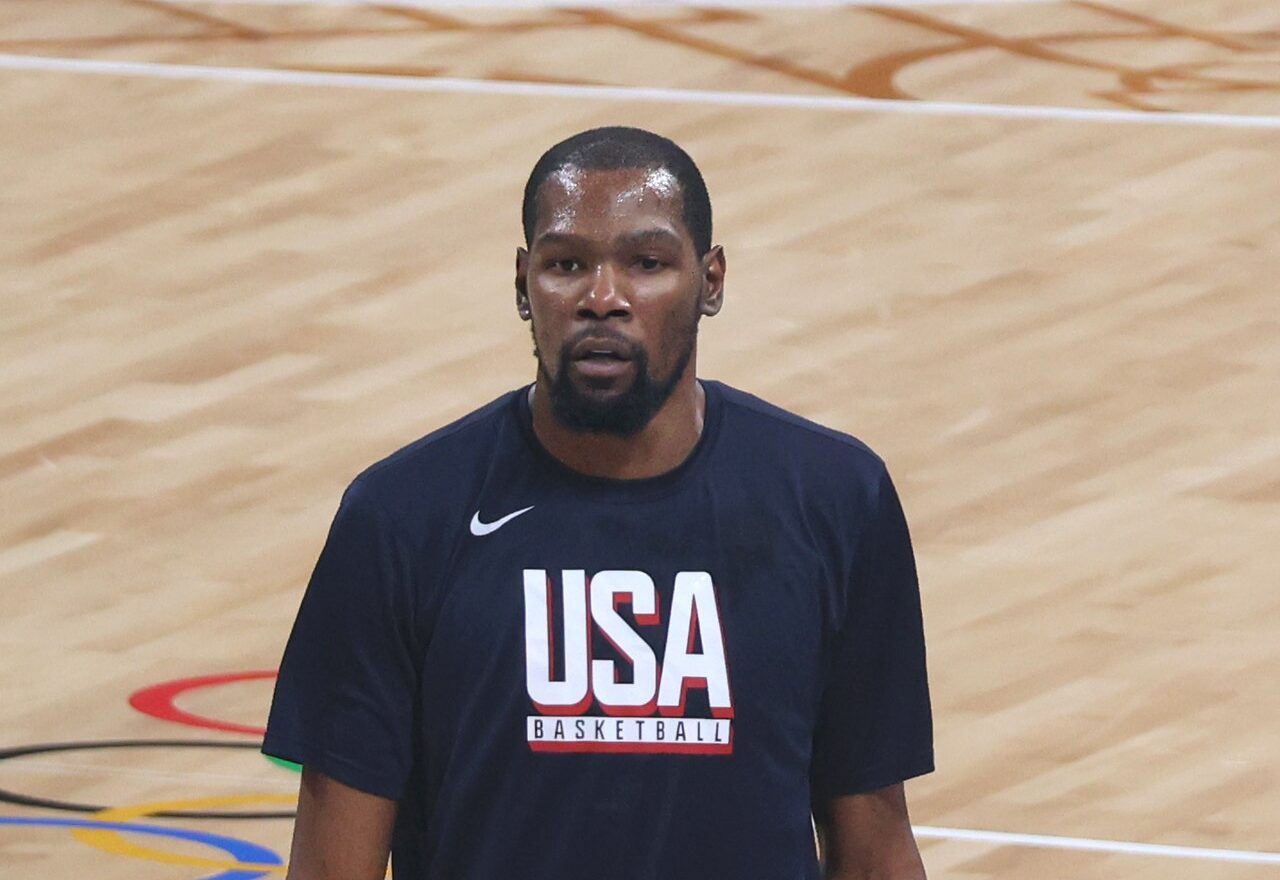
Photo: Clément Bardot, CC BY-SA 4.0, via Wikimedia Commons