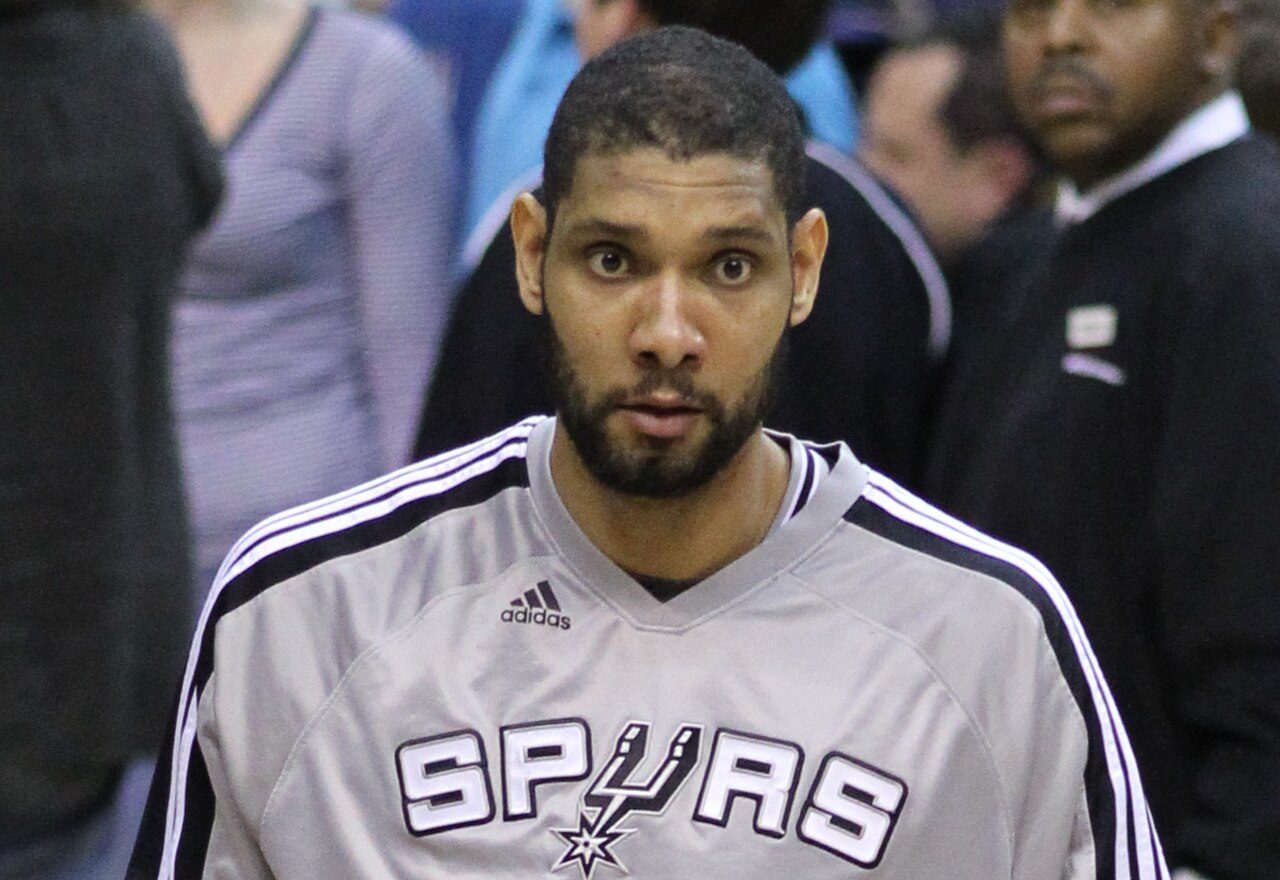
Five titles. Nineteen seasons. One franchise. Tim Duncan’s career was so steady that it almost disguised how rare it was.
For nearly two decades, the San Antonio Spurs built around a star who did not chase attention, did not change teams, and did not need a flashy game to control one end of the floor and often both. Known as “The Big Fundamental,” Duncan turned footwork, timing, patience and defensive discipline into one of the most durable résumés in NBA history.
From Saint Croix swimmer to late-start basketball prodigy
Timothy Theodore Duncan was born on April 25, 1976, in Saint Croix, U.S. Virgin Islands. Before basketball took over, swimming was his first sport. He was a strong enough swimmer to dream about Olympic competition, and for a while that looked like his path.
Then Hurricane Hugo changed it. The storm destroyed the island’s only Olympic-size pool, and Duncan, still in his early teens, shifted toward basketball. He was already older than many future stars when he seriously took up the game, starting around age 14. That late start became part of his story: he did not grow up with endless AAU mileage or a polished highlight reel. He learned the game later, and maybe because of that, he learned it methodically.
There were signs early that he developed on a slightly different track. He skipped a grade as a child, and people around him often noticed how calm and mature he seemed. At St. Dunstan’s Episcopal School and later St. Croix Country Day School, the outlines of his game began to show: balance, patience, and a feel for angles that would later define his NBA career.
Wake Forest made him the top prospect in the country
By the time Duncan arrived at Wake Forest in 1993, he was still relatively new to high-level basketball. It did not take long for that to stop mattering.
Across four college seasons, he grew into the best player in the country. He anchored Wake Forest with interior scoring, rebounding and shot blocking, and he left the school as one of the most decorated players in program history. In 1997, he won the Naismith College Player of the Year award, the John R. Wooden Award, and the USBWA’s Oscar Robertson Trophy.
Some of the old shorthand around his college numbers needs a little care. Duncan did finish with 1,570 career rebounds, but that was not the NCAA all-divisions record. It was, however, a major total that reflected exactly what he was: a dominant rebounder with elite timing around the rim.
He also stood out for reasons that had nothing to do with box scores. Duncan studied psychology at Wake Forest and was known as thoughtful and reserved, hardly the usual one-and-done celebrity archetype. He stayed in school for four years, sharpened his game, and entered the draft with a reputation for polish that proved accurate almost immediately.
The Spurs got the first pick and changed their future
The 1997 NBA Draft turned into one of the easiest franchise decisions ever made. San Antonio selected Duncan first overall, pairing him with David Robinson and giving the Spurs a new foundation.
His impact was immediate. As a rookie in 1997-98, Duncan averaged 21.1 points, 11.9 rebounds, 2.7 assists and 2.5 blocks per game, won Rookie of the Year, made the All-NBA First Team, and earned All-Defensive Second Team honors. Very few first-year big men arrive that complete.
That season also set the tone for everything that followed. Duncan was not a project. He was already a winning player, already one of the league’s best defenders, and already central to the Spurs’ identity.
He would remain with San Antonio from 1997 until his retirement in 2016, spending all 19 NBA seasons with the same team.
Titles, MVPs and the long Spurs run
The first championship came quickly. In the lockout-shortened 1998-99 season, Duncan led the Spurs to the title and won Finals MVP after San Antonio beat the New York Knicks.
Then came the peak within the peak. Duncan won back-to-back regular-season MVP awards in 2002 and 2003, and the 2003 title run remains one of the clearest examples of how much a single star can carry. He led the Spurs past the Nets in the Finals, won another Finals MVP, and nearly posted a quadruple-double in the closeout game.
By then, he was no longer just a great power forward. He was the center of one of the league’s defining dynasties.
San Antonio won again in 2005 and 2007, with Duncan still serving as the team’s anchor even as Tony Parker and Manu Ginóbili took on larger roles. In 2005, he earned his third Finals MVP after the Spurs beat Detroit in seven games. The 2007 championship completed another clinical postseason run.
The last title, in 2014, showed a different version of Duncan. He was no longer the offensive focal point he had been in his twenties, but he remained vital as a defender, rebounder and organizer on the floor. The Spurs’ revenge win over Miami gave him a fifth ring and made him the first player in NBA history to start on championship teams in three different decades.
The numbers from his career hold up cleanly: 1,392 regular-season games, all with San Antonio; averages of 19.0 points, 10.8 rebounds, 3.0 assists and 2.2 blocks; 50.6% shooting from the field. He was selected to 15 All-Star teams, made 15 All-NBA teams and 15 All-Defensive teams. At the time of his retirement, that defensive total was tied for the most in league history.
A few records capture his consistency better than any award list. Duncan never missed the playoffs. The Spurs won at least 50 games in every full season of his career. Because the 1998-99 season was shortened to 50 games by the lockout, San Antonio won 37 that year, which is often noted separately when people discuss the franchise’s remarkable run of 50-win quality. He also became the first player in NBA history to win 1,000 games with one team.
His career high was 53 points, scored against Dallas on December 26, 2001.
How Tim Duncan played
There were louder stars in his era, but few more reliable ones.
Duncan built his game on details: bank shots from the left side, quick post counters, perfect outlet passes, verticality at the rim, and constant defensive positioning. He could play power forward or center, and over time he effectively became both depending on the lineup around him.
The nickname “The Big Fundamental” fit because nothing looked wasted. He did not need dramatic gestures or high-volume scoring to dominate a game. He controlled pace with his decisions, erased mistakes on defense, and made teammates’ jobs easier. On some nights he was the first option. On others he was the structure holding the whole team together.
That style also helps explain his longevity. Duncan was never dependent on speed or leaping alone. As he aged, he adjusted without losing his value.
Contracts, salary and a team-first reputation
Duncan’s contracts reflected his status as San Antonio’s cornerstone. After his rookie deal, he signed a six-year contract in 2000 worth roughly $67 million, then a seven-year deal in 2003 worth about $122 million. Later in his career, he signed smaller contracts, including a three-year agreement in 2012 and a two-year deal in 2015, both below the kind of maximum salary a player of his stature might have pursued earlier in his career.
His total NBA earnings were a little over $240 million in salary. He also had endorsement deals, including work with Adidas and regional brands tied closely to San Antonio.
What mattered more than the raw number was the pattern. Duncan developed a reputation for accepting less than the maximum to help the Spurs keep competitive rosters together. That fit both his personality and the franchise’s long-term approach.
One Olympic run
His international résumé was short but notable. Duncan played for Team USA at the 2004 Olympics in Athens, where the Americans won bronze. For a player with such a long NBA career, it remains a relatively small chapter, but it is still part of the record.
Life away from the court
Off the court, Duncan was always more private than many stars of his stature, but a few themes stayed consistent: family, cars, paintball and philanthropy.
He married Amy Sherrill in 2001. Their divorce was finalized in 2013. They have two children together, a daughter, Sydney, and a son, Draven. Duncan has also been publicly linked to Vanessa Macias, and they have been reported to share a daughter, Quill. Because Duncan has kept much of his family life private, the broad outlines are public, but many personal details have remained intentionally low-profile.
He also developed business interests in San Antonio, including involvement with BlackJack Speed Shop, a custom auto business that matched his well-known interest in cars and trucks.
Then there was paintball, one of the more memorable details in the Tim Duncan biography. Teammates and coaches have long described it as a genuine hobby, not a one-off anecdote. It added a little texture to a public image that was otherwise famously controlled and understated.
His charitable work has been substantial. The Tim Duncan Foundation, established in 2001, has supported health and education initiatives, youth sports and community programs, with a particular focus on San Antonio and the U.S. Virgin Islands. Fundraising events tied to the foundation included bowling and golf outings, and the organization has supported causes such as the San Antonio Food Bank.
Financial loss and divorce reporting
Not every off-court chapter was smooth.
In 2015, Duncan sued his former financial adviser Charles Banks, saying he had been defrauded in investment dealings. Published reports widely described the losses as totaling more than $20 million, often around $25 million. Banks was later convicted in a federal fraud case involving Duncan and other clients. That episode was one of the most serious financial setbacks publicly connected to Duncan’s name.
His divorce also attracted tabloid coverage. Some reports and court-related claims included allegations of infidelity and rumors about his sexuality. Those claims were part of contentious divorce reporting and tabloid coverage; they were allegations and rumors, not established fact. There is no basis to present them as confirmed.
Retirement, Hall of Fame and place in NBA history
Duncan retired on July 11, 2016, ending one of the most accomplished single-franchise careers the league has seen. He later returned briefly to the bench as a Spurs assistant coach during the 2019-20 season.
The honors that followed were expected, but still significant. He was inducted into the Naismith Memorial Basketball Hall of Fame in 2021 as part of the 2020 class, after the ceremony was delayed. He was also named to the NBA 75th Anniversary Team.
A lot of great players leave behind a peak. Duncan left behind a structure: championships in different eras, elite defense that lasted almost two decades, and a model of how a superstar could be dominant without ever becoming noisy about it.
FAQ
How many championships did Tim Duncan win?
He won five NBA championships, all with the San Antonio Spurs.
What was Tim Duncan’s nickname?
His best-known nickname was “The Big Fundamental.”
Where did Tim Duncan play college basketball?
He played at Wake Forest from 1993 to 1997.
When was Tim Duncan drafted?
He was selected first overall by the Spurs in the 1997 NBA Draft.
When did Tim Duncan retire?
He retired from the NBA on July 11, 2016.
Did Tim Duncan play in the Olympics?
Yes. He played for Team USA at the 2004 Olympics in Athens and won a bronze medal.
Photo: Keith Allison from Owings Mills, USA, CC BY-SA 2.0, via Wikimedia Commons