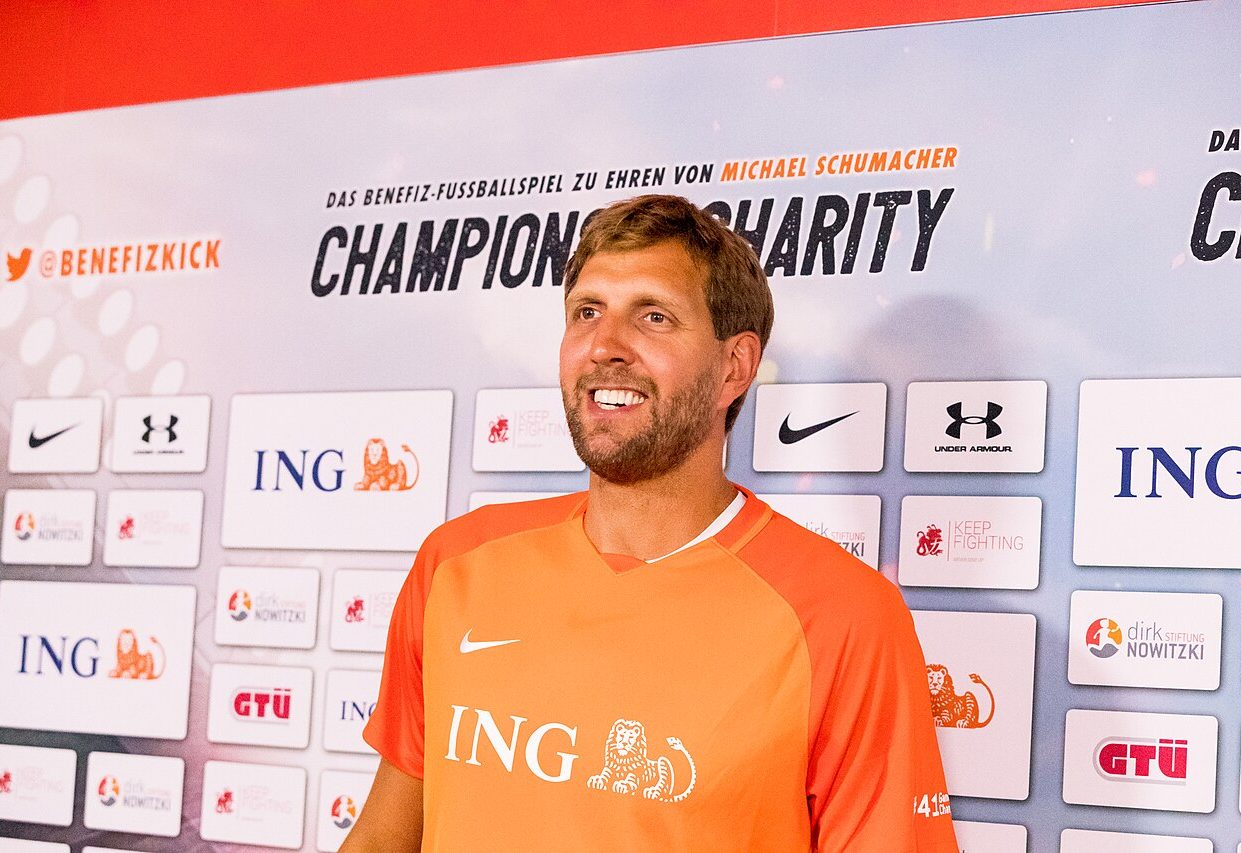
Forty-one hangs in the rafters in Dallas for a reason. Dirk Nowitzki stayed with one franchise for 21 seasons, scored 31,560 points, won an MVP award, and delivered the championship that had long eluded the Mavericks.
From Würzburg to a late start in basketball
Dirk Werner Nowitzki was born on June 19, 1978, in Würzburg, then in West Germany. Sports were the family trade. His mother, Helga, played professional basketball. His father, Jörg-Werner, played handball. His sister, Silke, also played basketball before later working in international basketball media.
What makes his rise unusual is how late it began. He first spent time in handball and tennis and did not seriously turn to basketball until he was around 13. For a player who would become one of the most influential shooting big men the sport has seen, that is a striking starting point.
Nowitzki developed with DJK Würzburg, playing for the club from 1994 to 1998. By the end of that stretch, he had become one of Europe’s most intriguing young prospects. The breakthrough moment for many NBA scouts came at the 1998 Nike Hoop Summit, where he scored 33 points and led the World Select Team to its first win over the United States junior team.
One detail in many summaries needs correcting here: he was not the German Bundesliga MVP in 1999 before entering the NBA. By then he was already in the league. His standout domestic season came in 1997-98, when he starred in Germany’s second division and helped Würzburg earn promotion.
Draft night, a quick trade, and a rough first year
The 1998 NBA Draft changed everything. Milwaukee selected Nowitzki with the No. 9 pick, but his rights were traded that night to the Dallas Mavericks in a deal tied to Robert Traylor and Pat Garrity. Dallas was betting on size, skill, and upside rather than a finished product.
The first season was not smooth. He averaged 8.2 points and 3.4 rebounds as a rookie in the lockout-shortened 1998-99 season and looked, at times, overwhelmed by the speed and physicality of the NBA. That part matters in any honest Dirk Nowitzki biography. His career was not an instant coronation. It was a climb.
Dallas stayed patient, and the payoff came quickly. In his second season, he jumped to 17.5 points per game. By his third, he was at 21.8. The Mavericks had found the player they could build around.
The rise of a new kind of star in Dallas
The early-2000s Mavericks became one of the league’s most entertaining teams, with Nowitzki at the center of it. Alongside Steve Nash and Michael Finley, he helped turn Dallas from a struggling franchise into a regular playoff team.
His game did not fit the old template for a 7-footer. He could handle the ball, face up, shoot from deep, and score without living on the block. The one-legged fadeaway became the signature shot, but the larger point was this: defenders had to guard him in places they were not used to guarding a player his size.
By 2001-02, he was an All-NBA player. Over the course of his career, he made 14 All-Star teams and 12 All-NBA teams. His All-Star selections came in 2002 through 2012, then again in 2014, 2015, and 2019. He earned All-NBA First Team honors in 2005, 2006, 2007, and 2009.
There were other markers that showed how unusual his skill set was. In 2006, he won the NBA Three-Point Contest, a rare line on the résumé of a 7-footer. In the 2006-07 season, he averaged 24.6 points, 8.9 rebounds, and 3.4 assists while shooting 50.2 percent from the field, 41.6 percent from three, and 90.4 percent from the line. That put him in the 50-40-90 club and helped earn him the 2007 NBA MVP award, making him the first European-born player to win the honor.
That season, however, also carried one of the sharpest disappointments of his career. Dallas won 67 games, then lost in the first round to Golden State. For a while, that upset followed him.
The title run that changed the story
A lot of stars put up numbers. The 2011 postseason is why Dirk Nowitzki is remembered differently.
Dallas entered those playoffs without the noise that usually follows a favorite. Then the Mavericks tore through the West, beating Portland, sweeping the two-time defending champion Lakers, and then defeating Oklahoma City in the conference finals. Nowitzki was brilliant throughout, mixing patience, touch, and late-game shotmaking.
In the NBA Finals, Dallas faced Miami. The series became the defining chapter of his career. The Mavericks won in six games, and Nowitzki was named Finals MVP after averaging 26.0 points and 9.7 rebounds in the series.
One of the enduring images came in Game 4, when he played despite being ill. Reports at the time said he was dealing with a fever, often described as 101 degrees, and he still scored the go-ahead basket late in the game. That detail has lasted because it fit the broader picture: he was never the loudest star in the league, but he was relentlessly dependable when Dallas needed offense.
The championship mattered beyond Dallas too. It gave Germany its first NBA title won by a German player and sealed his place among the most important international players in league history.
Records, longevity, and the final seasons
Nowitzki spent his entire NBA career with the Mavericks from 1998 to 2019. No player had ever logged more seasons with one franchise at the time he retired. Across 1,522 regular-season games, he averaged 20.7 points, 7.5 rebounds, and 2.4 assists.
His scoring total, 31,560 points, left him sixth on the NBA’s all-time list at retirement. He also became the highest-scoring foreign-born player in NBA history at that point, a mark later surpassed by LeBron James? No-that would be incorrect, since James is American-born. The foreign-born scoring record was later passed by other international stars, but at retirement it belonged to Nowitzki.
A few honors rounded out the picture. He was named to the NBA 75th Anniversary Team. The Naismith Memorial Basketball Hall of Fame inducted him in 2023. Dallas retired his No. 41 jersey in 2022, and Germany’s national team also retired the number.
One factual note also needs cleaning up: references to a FIBA Hall of Fame induction in 2026 should not be stated as an accomplished fact here unless tied to a confirmed induction. Without that confirmation in the source material, it is better left out.
Dirk Nowitzki with Germany
His international career was substantial on its own, not just a side note to the NBA years.
At the 2002 FIBA World Championship, Nowitzki led Germany to the bronze medal and was named tournament MVP. At EuroBasket 2005, he carried Germany to silver and again took MVP honors. In 2008, he served as Germany’s flag bearer at the Beijing Olympics.
Those runs mattered because Germany was not arriving at those tournaments as a global superpower. Much of the burden fell directly on him, and he embraced it. He finished his national-team career as the face of German basketball for a generation.
His individual recognition in Europe reflected that impact. He won the Euroscar Player of the Year award six times and was twice named FIBA Europe Men’s Player of the Year.
How he changed the way big men played
The easiest shorthand is to call him a stretch four, but that undersells him. Nowitzki helped normalize a style that is now common: the tall scorer who spaces the floor, attacks from the perimeter, and forces defenses to bend.
He played power forward most often, but he could slide across frontcourt positions depending on the lineup. His shooting touch was elite, his footwork was precise, and his release point made his jumper hard to contest even when defenders knew exactly what was coming.
The one-legged fadeaway became his trademark because it solved a basic problem. At 7 feet tall, with balance and touch, he did not need much separation. That shot let him score over length, over switches, and late in possessions. A generation of players studied it.
Life away from the court
Off the floor, Nowitzki has generally kept a low profile, especially by superstar standards. He married Jessica Olsson in 2012, and they have three children. Public reporting has identified them as a daughter, Malaika, and two sons, Max and Morris.
He has long been tied closely to Dallas, where he remained after retirement. He also built a significant charitable presence through the Dirk Nowitzki Foundation, which has supported children’s health, education, and well-being projects in North Texas, Germany, and parts of Africa.
Another detail that fits his image: for much of his career, he was known for operating without a traditional player agent, an unusual path for a star of his stature. His endorsement work was selective rather than sprawling. Nike was his most visible longtime brand partner, and he also worked with companies including Bauerfeind, Gatorade, Panini, Foot Locker, and Lufthansa.
After retiring in 2019, he stayed connected to the Mavericks as a special advisor, a role that reflected his standing within the organization without turning him into a daily front-office figure.
FAQ
How many championships did Dirk Nowitzki win?
He won one NBA championship, with the Dallas Mavericks in 2011.
What is Dirk Nowitzki’s signature move?
His signature move is the one-legged fadeaway jumper.
When was Dirk Nowitzki drafted?
He was selected in the 1998 NBA Draft with the ninth overall pick.
Is Dirk Nowitzki in the Hall of Fame?
Yes. He was inducted into the Naismith Memorial Basketball Hall of Fame in 2023.
How tall is Dirk Nowitzki?
He is listed at 7 feet 0 inches, or 2.13 meters.
How many points did Dirk Nowitzki score in the NBA?
He finished his NBA career with 31,560 points.
Photo: Sven Mandel, CC BY-SA 4.0, via Wikimedia Commons