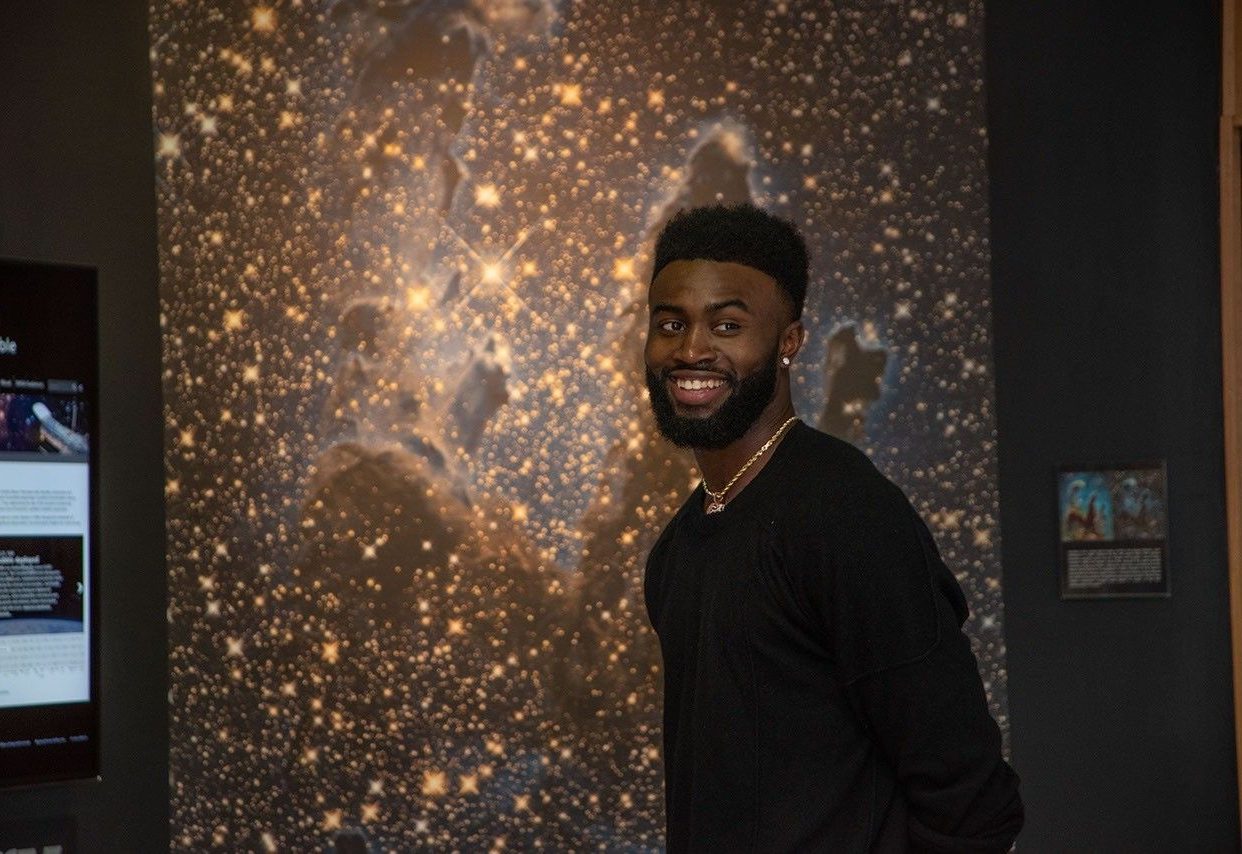
Third overall picks usually arrive with noise. Jaylen Brown arrived with that, too, but also with a reputation that felt a little different: a top recruit from Georgia who loved chess, asked bigger questions than most teenagers in the draft pipeline, and entered the NBA without hiring an agent.
Born on October 24, 1996, in Marietta, Georgia, Brown grew into one of the league’s premier two-way wings during a long run with the Boston Celtics. He helped deliver an NBA title, won Eastern Conference Finals MVP and NBA Finals MVP in the same postseason, and built a public image that stretched well beyond the court.
One note on the record before the story begins: the original version of this biography said Brown was traded to the Philadelphia 76ers in July 2026. That move is not part of the established public record, so it should not be presented as fact. Brown is best documented as a Celtics star through the championship phase of his career.
Wheeler High and the making of a top prospect
At Wheeler High School in Marietta, Brown quickly became one of the most closely watched players in the state. He played there from 2011 to 2015 and left with the kind of résumé that usually sends a player straight into the national spotlight.
In his senior year, he was named a McDonald’s All-American, Mr. Georgia Basketball and Gatorade Georgia Boys Player of the Year. Those honors confirmed what recruiters already knew: he had the frame, burst and scoring ability of an elite wing prospect.
Even then, though, Brown did not fit neatly into the usual blue-chip profile. He was also known for academic curiosity and for serving as captain of his school’s chess team, a detail that followed him into the NBA and became part of his public identity.
One season at Cal, and a fast rise
Brown chose California for college and spent the 2015-16 season with the Golden Bears. He played 34 games and averaged 14.6 points, 5.4 rebounds and 2.0 assists, showing the athletic force that made him such a coveted recruit while also flashing the rough edges of a young player still learning how to harness his gifts.
The honors came quickly. He was named Pac-12 Freshman of the Year and earned first-team All-Pac-12 recognition.
His year in Berkeley added to the sense that he was operating on a slightly different track from many future pros. Brown took a graduate-level course, “Cultural Studies of Sport in Education,” and spoke openly about interests that reached beyond basketball. That part of his image was real, not manufactured later.
Draft night and an unusual start in Boston
Boston selected Brown with the No. 3 pick in the 2016 NBA Draft. It was a significant bet by the Celtics, who saw star upside in a player whose tools were obvious but whose game still needed polish.
His path into the league was unusual. Brown did not hire a traditional agent for the draft process, instead leaning on the National Basketball Players Association for guidance. For a top-three pick, that stood out.
The rookie season was modest but promising. He came off the bench for much of the year, showed flashes as a slasher and defender, and finished on the NBA All-Rookie Second Team in 2017. Boston had not drafted a finished product. It had drafted a powerful athlete with room to grow, and the growth came steadily.
From raw talent to cornerstone
Brown’s Boston years are best understood as a climb rather than a sudden leap. Early on, he was asked to defend, run the floor and finish plays. Over time, his handle tightened, his footwork improved and his scoring package broadened. He became more comfortable pulling up from mid-range, more forceful attacking the rim and more reliable as a high-usage option.
By the 2017-18 season, he was already starting on a team that reached the Eastern Conference finals. In 2019-20, he averaged 20.3 points per game for the first time. The next year brought his first All-Star selection, a marker that he had moved from promising young piece to established upper-tier wing.
More All-Star appearances followed. Brown was selected again in 2023, 2024 and 2025, giving him four selections through the Celtics’ title era. He also made All-NBA Second Team in 2023.
That timeline matters, because some of the original biography’s claims did not line up cleanly with the public record. Brown was not a five-time All-Star by the end of Boston’s 2024 championship season, and any later totals should only be used if they can be verified.
Signature moments in green
Some players are remembered by averages. Brown’s Boston story is better told through moments.
On opening night of the 2021-22 season, he scored 46 points against the New York Knicks, the most ever by a Celtic in a season opener. It was a reminder of how far his offensive game had come. He was no longer just finishing plays created by others; he was carrying stretches of games himself.
Another milestone arrived on April 7, 2024, when he reached 10,000 career points. For a player once viewed as more athlete than scorer, it was a meaningful checkpoint.
Across his prime in Boston, Brown became one of the franchise’s central figures: a physical scorer on the wing, a transition threat, and a defender capable of taking difficult assignments when engaged.
The 2024 title run that changed the conversation
The defining chapter of Brown’s career came in the 2024 playoffs.
Boston won the NBA championship, and Brown was at the center of it. He earned Eastern Conference Finals MVP after a strong series against Indiana, then took NBA Finals MVP as the Celtics beat Dallas for the title.
That postseason did not invent his reputation, but it sharpened it. For years, Brown had been discussed as a gifted scorer, a high-level athlete and a key part of a contender. The championship run gave him the clearest possible credential. He had been one of the best players on the last team standing.
His Finals MVP was especially significant because it reflected the full shape of his game. He scored, defended, attacked in transition and handled pressure. It was not a one-note performance.
The supermax and the weight of expectations
In July 2023, Brown signed a five-year supermax extension worth up to $304 million with Boston, at the time the richest contract in NBA history.
Deals like that do two things at once: they reward a player and raise the volume around him. Every weakness gets revisited. Every playoff possession gets parsed. Brown experienced all of that.
One recurring criticism focused on his left hand, a talking point that resurfaced loudly during the 2023 playoffs and lingered into later discussions of his game. Some of that criticism was fair in basketball terms; some of it became lazy shorthand. Either way, it followed him. The title run in 2024 did not erase scrutiny, but it changed the balance of the conversation.
How he plays
Brown has long been most effective as a forceful two-way wing. At 6-foot-6, with strength, speed and explosive leaping ability, he puts pressure on defenses by getting downhill. He is comfortable finishing through contact, and his mid-range pull-up became a more dependable weapon as his career matured.
At his best, he plays with directness. There is not much wasted movement. He catches, attacks, rises and powers through defenders.
Defensively, his physical tools allow him to switch across positions, guard wings and survive against smaller guards in the right scheme. Like many high-usage stars, his consistency on that end can fluctuate, but his defensive ceiling has always been part of his value.
USA Basketball and the Olympic debate
Brown won gold with Team USA at the 2014 FIBA Americas Under-18 Championship and later played for the senior national team at the 2019 FIBA World Cup.
His absence from the U.S. Olympic roster for Paris in 2024 became a major talking point. Brown publicly questioned the process, and outside speculation followed. Some commentary suggested Nike’s influence may have played a role, but that remained speculation, not an established fact. It should be labeled that way.
Off the court: chess, education and business
This is where Brown’s profile separates itself from the standard NBA template.
He has long spoken about education, community work and intellectual interests with more seriousness than most athletes are expected to show in public. He became an MIT Media Lab Director’s Fellow and launched the Bridge Program, which focuses on youth mentorship and STEM exposure. His 7uice Foundation has also centered on education and economic opportunity.
In business, Brown has made similarly deliberate choices. He launched 7uice in 2021, presenting it as more than a clothing brand. In 2024, he introduced 741 Performance, his own shoe company, after choosing not to sign another major sneaker endorsement deal. Reports widely described that decision as him turning down offers worth more than $50 million, though exact figures should be attributed to published reporting rather than stated as settled fact.
Earlier in his career, he had an endorsement relationship with Adidas. He later signed an eyewear partnership with Oakley.
The personal details around his life should stay carefully sourced. Brown’s parents are Marcellus and Mechalle Brown, and he has a brother, Quenton. Real-estate reports have linked him to high-end property in Massachusetts, but those details are best framed as reported transactions rather than treated as central facts of his biography.
He has also served as an NBPA vice president, becoming one of the youngest players to hold that role.
Public friction, clarified
Brown’s career has not been free of controversy, and the distinctions matter.
In 2022, he faced criticism after sharing a video that appeared connected to the group Israel United in Christ during the fallout from Kyrie Irving’s promotion of anti-Semitic material. Brown later said he had not intended to support the group’s views. That clarification belongs with the incident.
He was also fined by the NBA for public criticism of officiating, another example of a player willing to speak bluntly.
As for rumors, they should remain clearly labeled. Internet chatter about unofficial nicknames and social-media claims are not the same as verified reporting. The same goes for periodic attempts to frame Brown and Jayson Tatum as rivals or feuding co-stars; that narrative was often overstated and, in public comments, pushed back on by those involved.
FAQ
What team did Jaylen Brown make his name with?
The Boston Celtics. He was drafted by Boston in 2016 and developed into an All-Star and champion there.
Has Jaylen Brown won an NBA championship?
Yes. He won the 2024 NBA title with the Celtics.
Was Jaylen Brown Finals MVP?
Yes. He was named NBA Finals MVP in 2024.
Where did Jaylen Brown go to college?
He played one season at California in 2015-16.
What position does Jaylen Brown play?
He is primarily a wing, usually listed as a shooting guard or small forward.
What is Jaylen Brown known for off the court?
He is known for interests in chess, education, community programs and business ventures such as 7uice and 741 Performance.
Photo: NASA, Public domain, via Wikimedia Commons