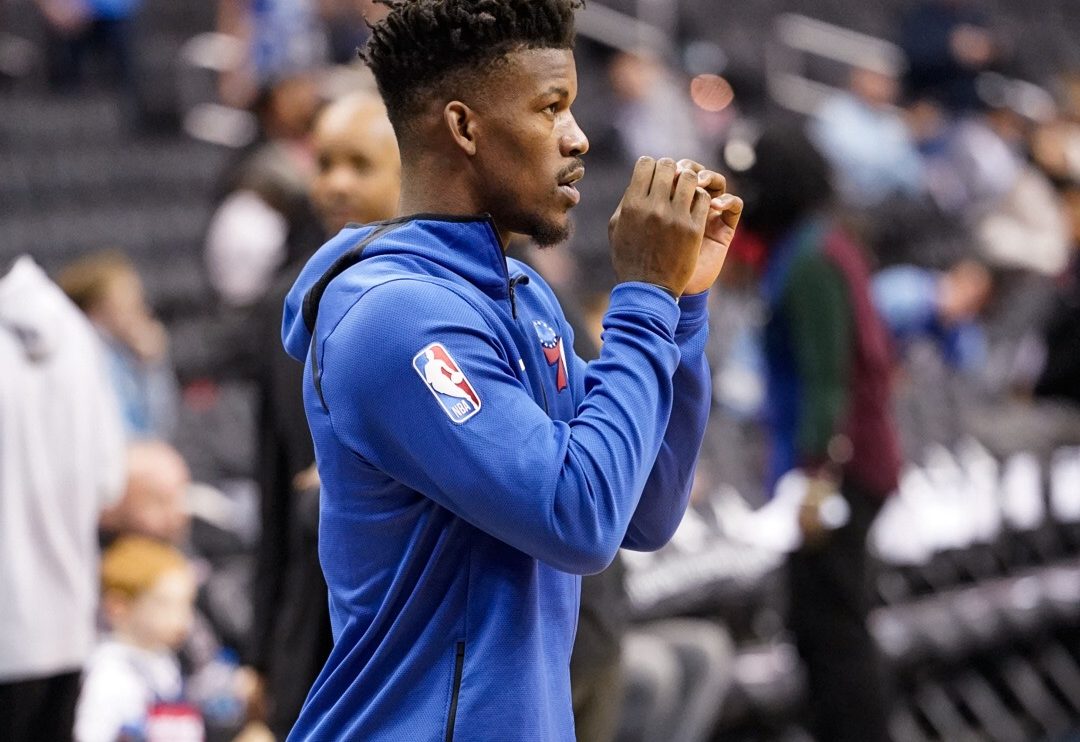
Six NBA All-Star selections, two trips to the Finals as a lead figure, an Olympic gold medal, and a career that started with the last pick of the first round. Jimmy Butler’s résumé makes more sense once you know how uneven the road was getting there.
Jimmy Butler’s early life: Houston, hardship, and an unlikely route
Jimmy Butler III was born on September 14, 1989, in Houston, Texas. The hardest parts of his story have been public for years: his father was absent, and Butler has said his mother told him to leave home when he was 13. For a stretch, he moved from house to house, staying with friends.
The turn came before his senior year of high school, when he was welcomed in by Jordan Leslie’s family. Michelle Lambert became a stabilizing presence in his life, and Butler has often spoken about what that support meant. It did not instantly make him a blue-chip prospect. He still left Tomball High School without major recruiting attention.
That sent him to Tyler Junior College, where his game began to catch up with his competitiveness. As a freshman, he averaged 18.1 points, 7.7 rebounds and 3.1 assists, earning NJCAA All-America honorable mention and all-region first-team honors. From there, he moved to Marquette, a much bigger stage and a more demanding basketball environment.
At Marquette, Butler was not a star on arrival. He developed year by year, which would become a theme of his career. Over three seasons, he grew into a reliable two-way wing and finished with more than 1,000 points and 500 rebounds. He was twice named All-Big East honorable mention. Reports from that period said the adjustment to the Midwest and to coach Buzz Williams’ intensity was not always smooth, but by the end of his college career he looked like an NBA player.
Chicago Bulls: where Jimmy Butler became Jimmy Butler
The Chicago Bulls selected Butler with the 30th pick in the 2011 NBA Draft. He entered a veteran team built around Derrick Rose, Joakim Noah and Luol Deng, and early on his role was narrow. Defense first. Energy. Minutes when trust had been earned.
That trust came slowly, then all at once.
In his first season, Butler barely played. By his second and third, he had become a fixture in Tom Thibodeau’s demanding rotation, guarding top perimeter scorers and playing heavy minutes. The offensive game took longer. He was not drafted as a primary scorer, and nobody was mistaking him for one at the start. But each season in Chicago added something: a stronger handle, better footwork, more comfort getting to the foul line, more confidence late in games.
By 2014-15, the leap was undeniable. Butler averaged 20.0 points per game, made his first All-Star team, and won the NBA’s Most Improved Player award. It was one of the clearest development arcs in the league: a defense-first wing turning into a complete offensive threat without losing the edge that got him on the floor in the first place.
His Bulls years produced three straight All-Star selections from 2015 through 2017, All-Defensive Second Team honors in 2014, 2015 and 2016, and All-NBA Third Team recognition in 2017. Across six seasons in Chicago, he averaged 15.6 points, 4.8 rebounds and 3.0 assists in the regular season.
That stretch also shaped his public image. Butler played hard, expected the same from teammates, and rarely softened his standards. In Chicago, that read less like branding than habit.
Minnesota Timberwolves: productive, brief, and tense
In June 2017, the Bulls traded Butler and the 16th pick to the Minnesota Timberwolves for Zach LaVine, Kris Dunn and the seventh pick, which became Lauri Markkanen. The move reunited him with Thibodeau, now coaching Minnesota.
On the court, the fit worked for a while. Butler gave the Timberwolves structure, late-game shot creation and defensive bite. In 2017-18, he averaged 22.2 points, 5.3 rebounds and 4.9 assists, made another All-Star team, returned to All-NBA Third Team, and helped Minnesota reach the playoffs for the first time in well over a decade.
But the stay never settled. Butler missed time late that season with a knee injury, then the relationship with the franchise frayed. His frustration with the team’s culture and with younger players became a major story. Much of what circulated publicly came through reported accounts rather than direct, complete public detail, but the broad outline was clear enough: he wanted out.
Minnesota traded him early in the 2018-19 season. The basketball was strong. The partnership was not built to last.
Philadelphia 76ers: one season, one unforgettable bounce
The next stop was Philadelphia, where Butler joined a 76ers team trying to push into contention. He played 55 regular-season games for Philly after the trade, averaging 18.2 points, 5.3 rebounds and 4.0 assists.
What mattered most was how naturally he fit playoff basketball. He could handle the ball, defend across positions, create offense when possessions got messy, and take pressure off Joel Embiid and Ben Simmons in tight games. For stretches, he looked like the team’s steadiest late-game option.
The 76ers’ season ended in one of the most famous finishes in league history: Kawhi Leonard’s four-bounce Game 7 winner for Toronto in the 2019 Eastern Conference semifinals. Butler had tied the game seconds earlier. Then the shot dropped, and his Philadelphia chapter ended almost as quickly as it had begun.
He left after one season, but it remains an important stop in the story. It sharpened the sense that his game was built for the postseason.
Miami Heat and the rise of “Playoff Jimmy”
A sign-and-trade sent Butler to the Miami Heat in July 2019. The pairing made sense immediately. Miami valued conditioning, discipline and internal accountability; Butler had built his career around all three.
His first season there ended in the NBA bubble, where he led the Heat to the 2020 Finals. That run changed the scale of his reputation. Butler was already respected. In Miami, he became something else in the playoffs: a player who could control games through force, timing and stamina, even without a scorer’s game built on volume threes.
In the 2020 Finals against the Lakers, he delivered two triple-doubles and one of the defining performances of his career in Game 5, when he played 47 minutes and finished with 35 points, 12 rebounds and 11 assists. Miami lost the series, but Butler’s standing rose.
The Heat years brought more than one deep run. In 2023, Miami reached the Finals again after entering the playoffs through the Play-In Tournament. Butler’s first-round series against Milwaukee supplied the loudest chapter of the “Playoff Jimmy” nickname. In Game 4, he scored a playoff career-high 56 points, the most in Heat postseason history, and followed it with 42 in the closeout game. He later won Eastern Conference Finals MVP as Miami beat Jayson Tatum and Boston in seven games.
His regular-season work in Miami was substantial too. Butler made All-Star teams in 2020, 2022, 2024 and 2025 while with the Heat, earned All-NBA Third Team in 2020 and 2021, All-NBA Second Team in 2023, and led the league in steals in 2021. He also made All-Defensive Second Team again in 2021.
Across his Miami regular-season tenure, he averaged 21.0 points, 6.0 rebounds and 5.7 assists. More than the numbers, he gave the Heat a tone. Games often bent toward his pace: physical, deliberate, and tense.
One note of factual care here: Butler did record multiple triple-doubles with Miami, but Dwyane Wade remains the franchise’s all-time leader in triple-doubles, not Butler.
Golden State Warriors: the next chapter
Butler later moved to the Golden State Warriors, adding another contender to a career that has rarely stayed still for long. He wears No. 10 with Golden State.
Because contract details and season-by-season numbers can change quickly, it is safer to frame this part without locking in figures that may date fast or conflict across sources. Reports from ESPN, including Shams Charania and Brian Windhorst, said Butler’s path to Golden State involved contract questions and hesitation about an extension before a new deal was reached. Those details were reported publicly, but they remain reported accounts of negotiation dynamics rather than facts Butler fully laid out himself.
What is established is the basketball fit. Even later in his career, Butler remained valuable for the same reasons he always had been: he can defend, create offense without dominating every possession, get to the line, and settle chaotic playoff possessions. On a veteran team, those skills travel.
USA Basketball, honors, and the shape of his game
Butler won Olympic gold with Team USA at Rio 2016, a fitting honor for a player whose value has always shown up clearly among other elite talent. He does not need every play called for him to influence a game.
His major honors include:
– 6× NBA All-Star
– 5× All-NBA selection
– 5× All-Defensive Second Team
– 2015 NBA Most Improved Player
– 2021 NBA steals leader
– 2023 Eastern Conference Finals MVP
– Olympic gold medal with Team USA
As a player, Butler has never been easiest to describe through one label. He has spent time at shooting guard and small forward, often functioning like a point forward in big moments. He is a strong wing defender, a patient half-court creator, and one of the league’s better foul-drawers at his position. His jumper has come and gone over the years, but his game has never depended on looking pretty. It depends on leverage, timing, footwork, strength and nerve.
Off the court: family, coffee, business, and charity
Off the floor, Butler can come off as both guarded and playful. He is known for intense work habits, but also for a dry sense of humor and a willingness to lean into odd details, which is part of why Big Face Coffee took off as a story during the bubble. What began as him selling coffee inside the campus environment became a real business identity and one of the more memorable side ventures any player launched during that period.
He is also a father. Butler has a daughter, and while he has spoken at times about fatherhood, much of his family life stays private, which is worth respecting rather than filling with speculation.
His business interests have expanded beyond coffee. Public reporting has linked him to sports investment groups and brand partnerships, though ownership stakes and deal structures should always be read carefully until formally completed. If a transaction is pending, it should be treated as pending, not final.
The charity record is better established. Butler has supported causes tied to youth services and hunger relief, including work in Chicago and Miami. During his Bulls years, he was recognized with the NBA Cares Community Assist Award for outreach efforts, and he has been involved in projects ranging from meals for people experiencing homelessness to community court refurbishments.
That part of the story fits the larger one. Butler’s career has always carried the marks of instability early, discipline later, and a stubborn insistence on making himself useful wherever he landed.
FAQ
Who does Jimmy Butler play for?
He has played for the Golden State Warriors most recently after earlier stops with the Bulls, Timberwolves, 76ers and Heat.
How old is Jimmy Butler?
Jimmy Butler was born on September 14, 1989.
Did Jimmy Butler win an NBA championship?
No. He has reached the NBA Finals twice, with Miami in 2020 and 2023, but has not won a title.
Why is Jimmy Butler called “Jimmy Buckets” and “Playoff Jimmy”?
“Jimmy Buckets” refers to his scoring, while “Playoff Jimmy” grew from his habit of producing some of his best games in the postseason.
Where did Jimmy Butler go to college?
He played first at Tyler Junior College, then at Marquette University.
What position does Jimmy Butler play?
He has mainly played shooting guard and small forward, while often handling playmaking duties as well.
Photo: All-Pro Reels, CC BY-SA 2.0, via Wikimedia Commons