At the 2013 NBA Draft Combine, Rudy Gobert posted a standing reach of 9-foot-7, one of the most eye-catching measurements scouts had ever seen. It was an early clue to the kind of NBA player he would become: not a flashy scorer, but a center who could swallow space, erase shots and make teams think twice about entering the paint.
From Saint-Quentin in northern France to the middle of elite NBA defenses in Utah and Minnesota, Gobert built his career on that identity. He became one of the league’s defining rim protectors, won the NBA Defensive Player of the Year award four times, and matched the record long shared by Dikembe Mutombo and Ben Wallace.
Growing up in Saint-Quentin
Rudy Gobert-Bourgarel was born on June 26, 1992, in Saint-Quentin, France. Basketball was part of his life early. His father, Rudy Bourgarel, was a former French international who had also played college basketball at Marist from 1985 to 1988. His mother, Corinne Gobert, raised him in Saint-Quentin after his parents separated when he was young.
He started playing with JSC St-Quentin in 2003, then moved through the local system before joining the Cholet Basket training center in 2007. That step mattered. Cholet had a strong reputation for player development, and Gobert arrived there as a tall, still-growing prospect whose game was far from finished.
By 2009, he was playing for Cholet’s junior side. The raw tools were obvious, but so was the need for patience. He was long, mobile for his size, and instinctive around the rim, yet still learning how to use that frame against stronger, older players.
Cholet and a fast rise
Gobert made his senior debut for Cholet during the 2010-11 season. Over the next two years, his production began to move in the right direction. In 2011-12, he averaged 4.2 points and 3.6 rebounds in 29 games. In 2012-13, those numbers climbed to 8.4 points and 5.4 rebounds across 27 games.
The box score alone did not fully explain why NBA teams were interested. His value was in projection. Scouts saw a center with unusual length, soft hands around the basket and the potential to become a high-level defender if his body and awareness kept developing.
Then came the combine. Gobert’s measurements, especially that standing reach, turned him from an intriguing international prospect into one of the more discussed big men in the class.
In the 2013 NBA Draft, the Denver Nuggets selected him with the 27th overall pick. He did not stay there. On draft night, his rights were traded to the Utah Jazz, the team that would shape the first major chapter of his NBA career.
Utah Jazz: from project to defensive anchor
Gobert’s first NBA season was not a straight line upward. He spent part of 2013-14 with the Bakersfield Jam in the NBA Development League, a common stop for young players who needed minutes and structure. Utah was patient with him, and that patience paid off.
As the years went on, he became the backbone of the Jazz defense. His game was clear and narrow in the best sense: protect the rim, finish at the basket, rebound everything in reach, and give the rest of the defense a safety net behind them.
By the middle of his Utah run, he was no longer just a useful big man. He was one of the league’s most influential defenders.
He led the NBA in blocks in 2016-17 and earned All-NBA Second Team honors that same season. Later came All-NBA Third Team selections in 2018-19, 2019-20 and 2020-21. He was also voted an All-Star in 2020, 2021 and 2022.
The biggest awards came on defense. Gobert won Defensive Player of the Year in 2018, 2019 and 2021, while making the All-Defensive First Team six straight times from 2017 through 2022. In 2021-22, he also led the league in rebounds.
Utah’s belief in him showed up in contract form as well. In October 2016, he signed a four-year extension worth $102 million. In December 2020, he agreed to a five-year supermax extension worth $205 million.
For all the focus on blocks, his offensive role also became highly efficient. He was never a player teams ran offense through, but he turned lobs, dump-offs and put-backs into easy points and routinely ranked among the league leaders in dunks. In a Jazz system built around spacing and pick-and-roll play, that mattered.
A difficult moment in 2020
One of the most discussed episodes of Gobert’s career had nothing to do with a rebound or a blocked shot.
In March 2020, he tested positive for COVID-19, becoming the first NBA player publicly confirmed to have the virus. Earlier that week, he had jokingly touched microphones and recorders at the end of a media session, a moment that was replayed constantly once the diagnosis became public. The NBA suspended its season that night.
Gobert later apologized, and the incident remained attached to his public image for a long time. It was a serious misstep, and also one of the strangest, most consequential off-court moments involving any player of his era.
The trade to Minnesota
After nine seasons in Utah, Gobert was traded to the Minnesota Timberwolves in July 2022. The deal was one of the biggest of that offseason, and it signaled how highly Minnesota valued what he could bring to its defense.
His first season with the Timberwolves was uneven at times, as he adjusted to a new roster and a new frontcourt partnership. Even so, he averaged 13.4 points, 11.6 rebounds and 1.4 blocks in 2022-23.
The second year looked more like the version Minnesota had hoped to get. In 2023-24, he played 76 games and averaged 14.0 points, 12.9 rebounds, 2.1 assists and 2.1 blocks while shooting 66.1 percent from the field. More importantly, he anchored one of the league’s best defenses and won Defensive Player of the Year for the fourth time.
That award put him in rare company. Only Mutombo and Ben Wallace had won it four times before him.
Minnesota later agreed to a contract extension with Gobert in October 2024. Financial figures tied to NBA contracts and career earnings can change depending on guarantees, options and reporting updates, but the broader point was clear: the Timberwolves remained committed to him as a central piece of their defense.
France, medals and a major international role
Long before he became a familiar NBA name, Gobert was part of France’s national-team pipeline. He joined the senior setup in 2012, though he did not make the final Olympic roster that summer.
He soon became a fixture.
With France, he won bronze at the 2014 FIBA World Cup and again at the 2019 World Cup. He added a bronze medal at EuroBasket 2015 and a silver at EuroBasket 2022. At the Olympics, France finished sixth in Rio in 2016 and then won silver at the Tokyo Games, which were played in 2021 after being postponed.
International basketball has often shown another side of his value. In FIBA play, where the paint can get crowded and possession-by-possession defense matters even more, his size and timing become even harder to ignore. France has regularly leaned on him as the anchor of its front line.
He was named French Player of the Year in 2019.
How Rudy Gobert plays
Some centers dominate with post scoring. Others stretch the floor. Gobert’s impact starts somewhere simpler and, for opponents, more annoying: he takes away easy shots.
At 7-foot-1 with a reported 7-foot-9 wingspan, he covers ground quickly around the rim and changes possessions even when he does not record the block. Guards think about him when they turn the corner. Wings hesitate when they drive. Teammates can pressure the ball more aggressively because they know he is behind them.
Offensively, he has stayed within his strengths. He screens hard, dives to the rim, finishes efficiently and cleans up misses. He has never needed a deep scoring package to matter. His game is about pressure points: vertical spacing on one end, paint control on the other.
“The Stifle Tower” is a nickname that stuck because it fits. It nods to his French roots and to the way he can make the lane feel closed.
Off the court
Away from basketball, family has remained a visible part of Gobert’s story. He has spoken over the years about his upbringing in Saint-Quentin and the influence of both parents. In May 2024, he missed a Timberwolves playoff game for the birth of his child, a personal moment that briefly pulled him away from one of the biggest series of his career.
Some reports have linked him romantically to influencer Hannah Stocking, including claims repeated by entertainment and sports sites. Those reports have circulated publicly, but private-life details of that kind should be treated as unconfirmed unless the people involved state them directly.
Real-estate details tied to athletes are often reported through local media and property records, though not every figure is independently confirmed by the player. Gobert has also been associated with endorsement work and charitable efforts, including Rudy’s Kids Foundation, which supports children and youth.
Rudy Gobert in context
Gobert’s career has never followed the usual superstar template. He is not defined by scoring titles or isolation highlights. His case has always been more specific than that.
He became one of the era’s most important defensive centers by doing the hard, repetitive work that shapes winning basketball: contesting, rotating, rebounding, screening, finishing and organizing the back line of a defense. That profile does not always make for the loudest reputation, but it has made for a long and decorated career.
FAQ
How many Defensive Player of the Year awards does Rudy Gobert have?
He has won four: 2018, 2019, 2021 and 2024.
What team does Rudy Gobert play for?
He plays for the Minnesota Timberwolves.
How tall is Rudy Gobert?
He is listed at 7-foot-1 (2.16 meters).
What is Rudy Gobert’s nickname?
He is widely known as “The Stifle Tower.”
Did Rudy Gobert win an NBA championship?
No, he has not won an NBA title.
Has Rudy Gobert played for France?
Yes. He has represented France in the Olympics, FIBA World Cup and EuroBasket, winning multiple medals, including Olympic silver.
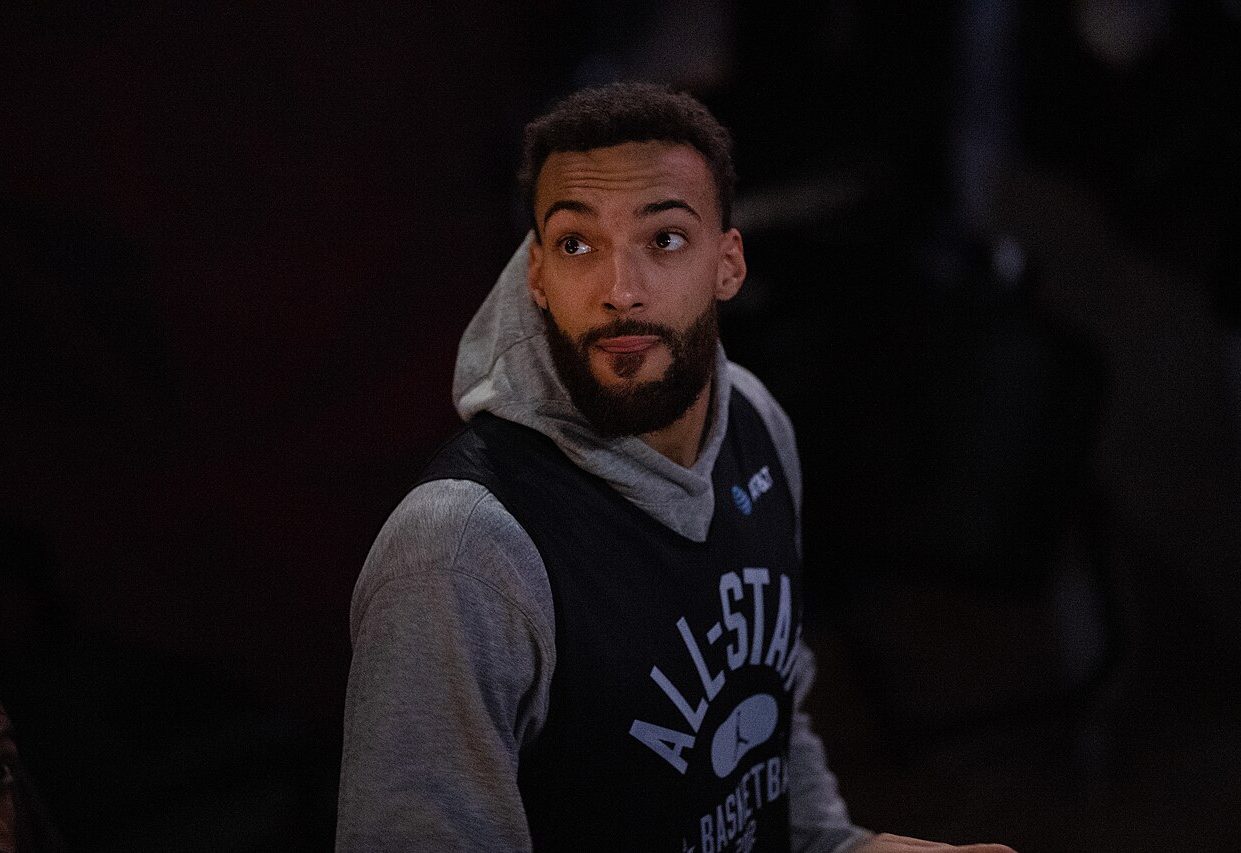
Photo: Erik Drost, CC BY 2.0, via Wikimedia Commons