At 17, Franz Wagner was already stepping onto the floor in Germany’s top league. That early start said plenty about how he was viewed in Berlin: not as a long-term project, but as a player trusted to grow against professionals.
Born in Berlin on August 27, 2001, Franz Jacob Wagner came through the Alba Berlin system, one of Europe’s best development pipelines. He spent time with Alba’s senior setup and also played for SSV Lokomotive Bernau during the 2018-19 season, a common route for young players needing minutes against older competition. The numbers were modest, 4.6 points and 1.3 rebounds in 12.4 minutes across 35 Bundesliga games, but the context mattered more. He was a teenager learning how to survive in a professional game built on spacing, timing and physicality.
That season brought an early individual honor as well. Wagner was named the Bundesliga’s Best German Young Player in 2019, a sign that his progress was being noticed beyond Alba’s own program.
Leaving home for Michigan
The next major turn in his career came with a choice that was not automatic for a player on a strong European track. Rather than stay in Germany and continue as a pro, Wagner went to the United States to play college basketball at Michigan, following a path his older brother Moritz had already taken.
It was a significant move. Michigan offered a different kind of development: more on-ball responsibility, more exposure to NBA scouts, and a chance to test his game in a new setting.
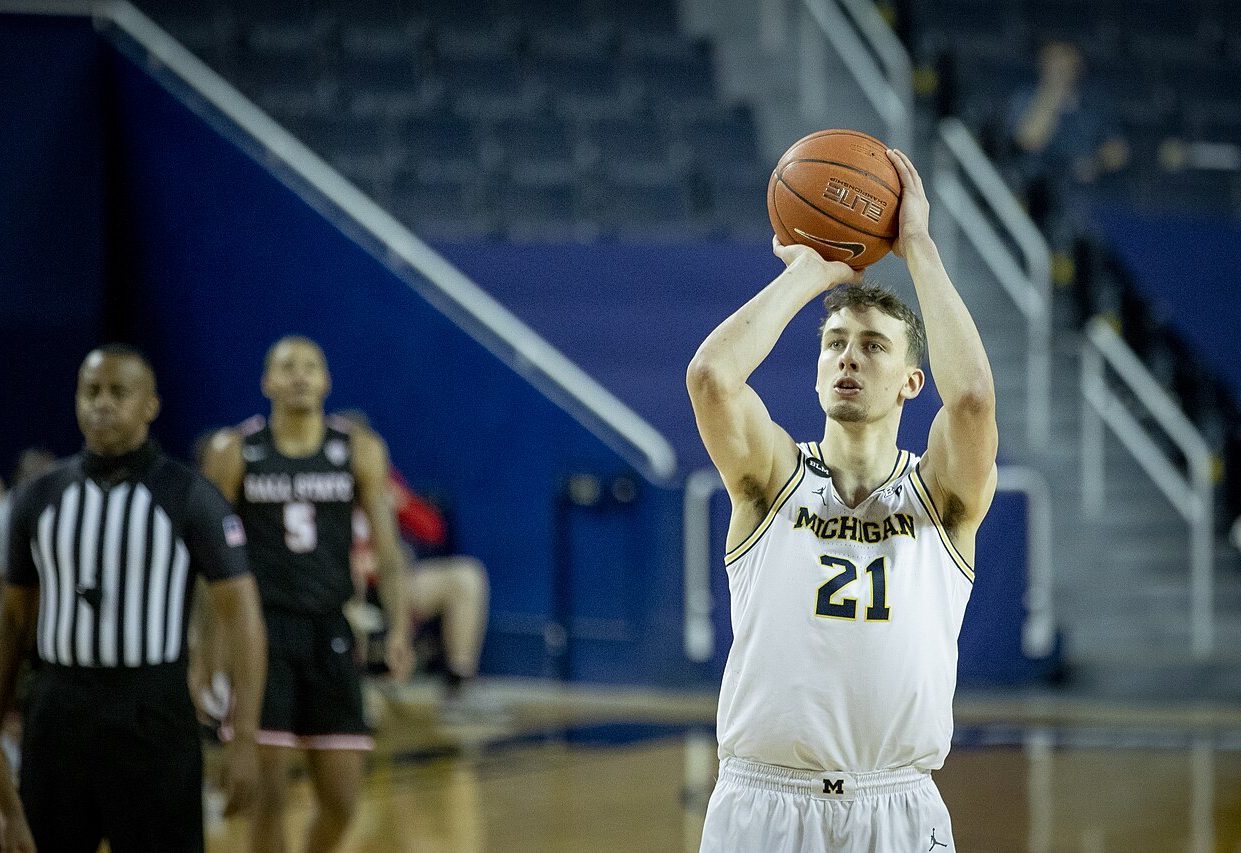
As a freshman in 2019-20, Wagner played 27 games and averaged 11.6 points, 5.6 rebounds and 1.0 assists. He made the Big Ten All-Freshman Team, and what stood out was not just the production. He looked comfortable doing several jobs at once, defending on the wing, moving without the ball, finishing in traffic and making quick reads.
His second season sharpened that picture. In 2020-21, he averaged 12.5 points, 6.5 rebounds and 3.0 assists in 28 games while helping Michigan win the Big Ten regular-season title and reach the Elite Eight. He earned second-team All-Big Ten from the coaches, third-team All-Big Ten from the media, and first-team Academic All-American honors.
By the time he left Ann Arbor, scouts were no longer trying to decide whether he was a forward or a guard in the traditional sense. The appeal was that he could function as a bit of both. He had size at 6-foot-10, enough handle to initiate offense, and the kind of defensive mobility teams value in the modern NBA.
Draft night and a fast start in Orlando
The Orlando Magic selected Wagner with the No. 8 pick in the 2021 NBA Draft, making him a top-10 pick and one of the key pieces in the franchise’s rebuild. He signed his rookie-scale contract shortly afterward and moved quickly from prospect to rotation mainstay.
His first season did not feel like a slow introduction. Wagner played with unusual poise for a rookie, earning NBA All-Rookie First Team honors in 2022. He was also named Eastern Conference Rookie of the Month for December 2021 and appeared in the Rising Stars event during All-Star weekend in both 2022 and 2023.
What made that rookie year notable was how complete it looked. He was not simply scoring off broken plays or living on transition baskets. Orlando used him in different ways, attacking closeouts, handling in pick-and-roll, cutting from the weak side, and defending multiple positions. For a young team trying to establish an identity, that versatility mattered.
Over the next few seasons, Wagner became one of the central figures for the Magic alongside Paolo Banchero. His scoring climbed, but so did his offensive responsibility. He was no longer just fitting into possessions. He was helping shape them.
In July 2024, Orlando agreed to a five-year maximum rookie extension with Wagner. The deal was widely reported at $224 million over five years, with the potential to rise higher if he met certain award criteria. According to ESPN’s reporting at the time, the contract could have reached roughly $269 million if he qualified for the higher “Rose Rule” percentage by making an All-NBA team. That possibility was contingent, not guaranteed.
The extension underlined how the organization viewed him: not as a complementary piece, but as part of its foundation.
Growth, pressure and playoff basketball
Wagner’s game has continued to expand in Orlando. He has developed into a reliable scorer who can get downhill, finish with either hand and use his size to create angles smaller defenders cannot handle. He is also a strong cutter, which makes him useful next to other creators, and a willing passer who can keep the ball moving without dominating it.
Defensively, he has long carried value beyond the box score. Wagner can switch across positions, stay attached on the perimeter and use his length to bother drives and passing lanes. Coaches tend to trust players like that because they can solve lineup problems without needing the offense built entirely around them.
One of the more significant interruptions in his NBA run came in December 2024, when he suffered a torn right oblique. He returned in January 2025, an important reminder that even durable young players hit setbacks. The broader arc, though, remained intact: he was still one of the Magic’s most important two-way players and one of the leading German basketball figures of his generation.
Germany’s rise and Wagner’s place in it
Before he was an NBA regular, Wagner was already part of Germany’s national-team structure. He played at the FIBA U16 European Championship in 2017, appeared at the Albert Schweitzer Tournament in 2018, and competed at the FIBA U18 European Championship in 2019.
Germany won the Albert Schweitzer Tournament in 2018, an early youth-level success in a program that would soon take much bigger steps.
The senior breakthrough came later, and on a much larger stage. Wagner helped Germany win bronze at EuroBasket 2022, then played a major role in the country’s first FIBA World Cup title in 2023. That tournament changed the way Germany was discussed internationally. It was no longer a team with interesting pieces and upset potential; it was the world champion. Wagner was named to the All-FIBA World Cup Second Team, recognition of both his scoring and his all-around impact.
He remained central to Germany’s next major campaigns. At the Paris Olympics in 2024, Germany finished fourth, and Wagner was named to the All-Second Team of the men’s Olympic tournament. At EuroBasket 2025, Germany won gold, adding another major medal to a résumé that already included youth success, a European bronze and a World Cup title.
For German basketball, that run marked a historic stretch. For Wagner personally, it confirmed that his influence translated across formats and roles, whether he was sharing touches with NBA-level teammates or carrying more of the scoring load.
Why his game works
Wagner is often described as versatile, and in his case the word fits. He can play as a small forward, slide to power forward, and handle enough to function as a secondary creator. At Michigan, some lineups even used him in ways that resembled a big guard. In the NBA, that flexibility has only become more useful.
Offensively, his strengths are built less on flash than on timing and balance. He changes pace well, gets to the rim without wasting dribbles, and knows how to use his frame to shield defenders. His jumper has become an important part of the package, but his value is not tied to one skill alone. He can score, pass, cut and keep possessions organized.
Defensively, he does connective work that coaches notice quickly. He can guard wings, switch onto bigger players in stretches, and hold up well enough against ball handlers to keep a scheme intact. That is a big reason he has been valuable at every stop, from Alba Berlin to Michigan to the Orlando Magic.
Off the court: family, routine and a bit of personality
Basketball is woven into Wagner’s family life. His older brother, Moritz Wagner, also played at Michigan and later became his teammate in Orlando. Their mother, Beate Wagner, has been identified in published profiles as a former player and a medical professional, while their father, Axel Schulz, has also been part of the family’s basketball background. Those family links help explain why the sport has looked so natural in Wagner’s life for so long.
Some of the smaller details around him are revealing too. Former teammate Max Stürzel has been quoted in German media describing Wagner as unusually committed to shooting work during his youth, a player who kept returning to the gym during tournaments. Stories like that are difficult to quantify, but they fit the broader picture of his development: steady, disciplined, and rarely rushed.
Away from the court, Wagner has kept a fairly low public profile. His social media presence is light by NBA standards, and even the most widely noticed detail, his Instagram handle, “Franz_weasley”, lands more as a glimpse of humor than a branding exercise.
That restraint matches the player. Franz Wagner has built his career without much noise, moving from Berlin gyms to college basketball, from the NBA draft to playoff pressure, and from youth tournaments to the top of the international game.
FAQ
Is Franz Wagner related to Moritz Wagner?
Yes. Moritz Wagner is his older brother, and the two have been teammates with the Orlando Magic.
What team does Franz Wagner play for?
He plays for the Orlando Magic.
When was Franz Wagner drafted?
He was selected by Orlando with the eighth overall pick in the 2021 NBA Draft.
Where did Franz Wagner play college basketball?
He played for the Michigan Wolverines from 2019 to 2021.
Has Franz Wagner won medals with Germany?
Yes. He won bronze at EuroBasket 2022, gold at the 2023 FIBA World Cup, and gold at EuroBasket 2025. He also won the 2018 Albert Schweitzer Tournament at youth level.
What position does Franz Wagner play?
He is primarily a forward, usually listed as a small forward or power forward, but he also handles the ball enough to function as a secondary playmaker.
Photo: Marc-Gregor Campredon / MGoBlog, CC BY-SA 2.0, via Wikimedia Commons