42 triple-doubles in a single season once sounded impossible. Russell Westbrook made it routine enough to reset the record, then kept going until his name sat alone at the top of one of the NBA’s strangest and most demanding categories.
Russell Westbrook: the late-blooming guard from Long Beach
Russell Westbrook III was born on November 12, 1988, in Long Beach, California, and his rise did not follow the usual prodigy script. At Leuzinger High School in Lawndale, he was not a can’t-miss star from day one. He was cut from the varsity team as a freshman and had to wait until his junior year to become a starter.
A growth spurt changed the picture. Westbrook went from roughly 5-foot-8 to about 6-foot-3 before his senior season, and suddenly the speed, aggression and defensive energy that had always been there fit an NBA-sized frame. Another event shaped him more deeply. His close friend and teammate Khelcey Barrs III died after collapsing during a pickup game, a loss Westbrook has often carried with him publicly, including the “KB3” wristbands he wore in tribute.
By the time he finished high school, he was no longer an overlooked guard. He had turned himself into a serious college prospect, not through early fame, but through late development and relentless work.
UCLA gave him structure, and the NBA saw the upside
Westbrook stayed close to home and joined UCLA, where he played from 2006 to 2008 under Ben Howland. He was not the headline name when he arrived, but his role grew quickly. In two seasons with the Bruins, he helped UCLA reach back-to-back Final Fours in 2007 and 2008.
His sophomore year showed the outline of the player he would become: disruptive on defense, explosive in transition, and increasingly hard to keep out of the lane. He earned Pac-10 Defensive Player of the Year honors in 2008 and was named Third-team All-Pac-10.
That was enough for NBA teams to bet on the tools and the motor. In the 2008 NBA Draft, the Seattle SuperSonics selected him with the No. 4 pick. Soon after, the franchise relocated and became the Oklahoma City Thunder, tying the start of Westbrook’s pro career to a team beginning from scratch in a new city.
Oklahoma City: from raw athlete to franchise engine
Westbrook entered the league as a blur of speed and force, and the early years in Oklahoma City were about learning how to channel both. He made the NBA All-Rookie First Team in 2009, and as the Thunder rose, so did his place in the league.
Alongside Kevin Durant and James Harden, he helped turn Oklahoma City into a contender. The Thunder reached the NBA Finals in 2012, losing to the Miami Heat, but that run established Westbrook as more than a talented athlete. He was now one of the central guards in the league’s competitive landscape.
His résumé in Oklahoma City grew fast. He became a regular All-Star, eventually making nine straight All-Star teams from 2011 through 2020. He won All-Star Game MVP in 2015 and 2016. His All-NBA selections stacked up too: First Team in 2016 and 2017, Second Team in 2011, 2012, 2013, 2015 and 2018, and Third Team in 2019 and 2020.
Then came the season that defines almost every Russell Westbrook biography.
The MVP season and the triple-double years
The 2016-17 season was chaos, volume and production all at once. After Durant left Oklahoma City, Westbrook took on one of the heaviest workloads in the league and responded by averaging a triple-double: 31.6 points, 10.7 rebounds and 10.4 assists per game. He won the NBA MVP award and broke Oscar Robertson’s longstanding single-season record with 42 triple-doubles.
That season did not stand alone. Westbrook averaged a triple-double for four different seasons: 2016-17, 2017-18, 2018-19 and 2020-21. He was the first player in NBA history to do it in back-to-back seasons, then kept extending the feat until it became part of his identity.
He also led the league in scoring twice, in 2014-15 and 2016-17, and in assists three times, in 2017-18, 2018-19 and 2020-21.
What made those numbers unusual was not just the totals. Westbrook rebounded like a forward, attacked the rim like a wing and handled the ball on nearly every important possession. At his best, he played as if every loose ball, every defensive rebound and every transition chance belonged to him first.
In September 2017, he signed a five-year supermax extension with Oklahoma City worth about $205 million, at the time the largest contract in NBA history.
A career on the move: Houston, Washington and the Lakers
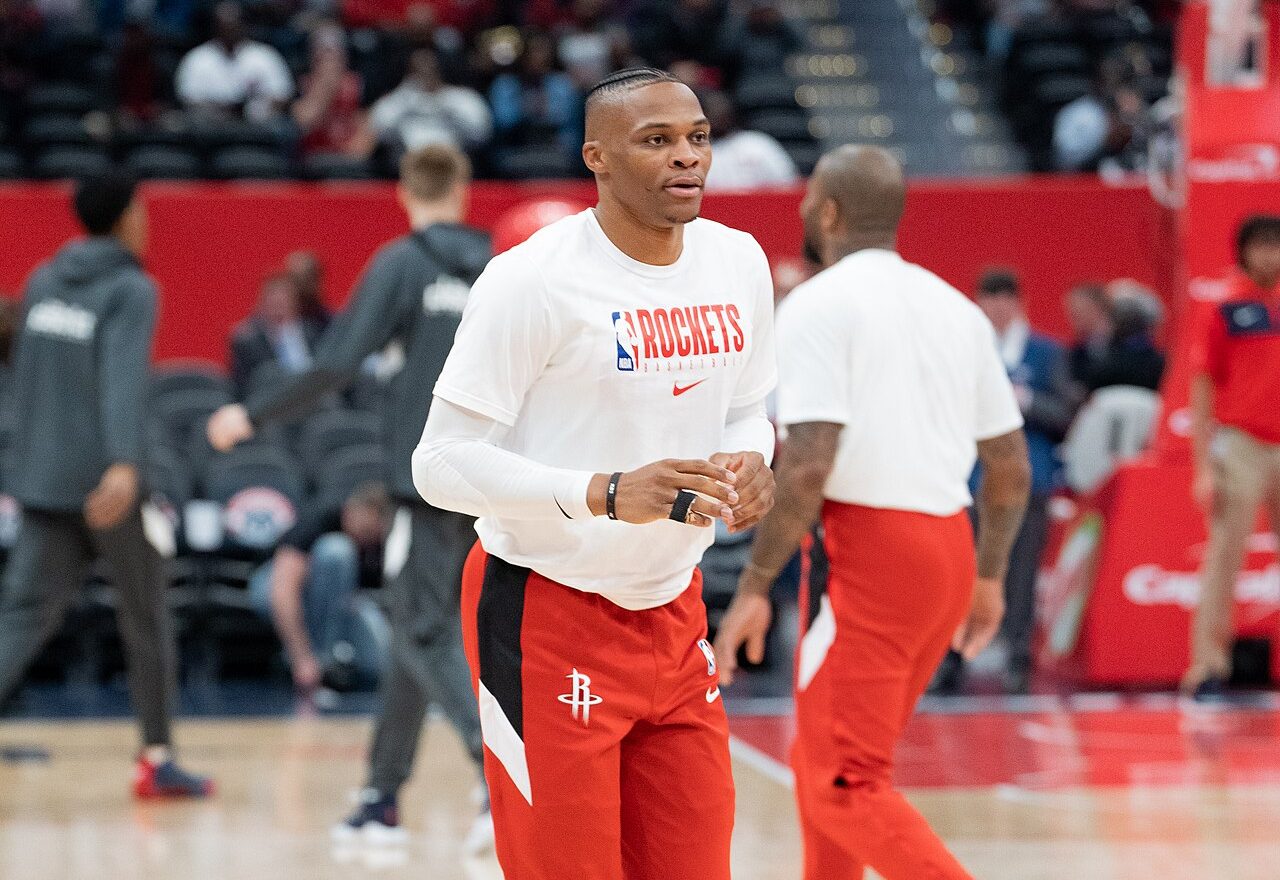
After 11 seasons with the Thunder, Westbrook’s career changed direction. In July 2019, Oklahoma City traded him to the Houston Rockets, reuniting him with Harden. His lone season in Houston was productive but uneven, and the partnership lasted only one year.
In December 2020, he was traded to the Washington Wizards. That stop was brief, but it produced another major milestone. On May 10, 2021, Westbrook recorded the 182nd triple-double of his career, passing Oscar Robertson for the most in NBA history. He also led the league in assists that season with 11.7 per game.
A few months later, in August 2021, he was traded to the Los Angeles Lakers. The fit was heavily scrutinized from the start. His time with the Lakers included flashes of his old force, but also constant attention on spacing, turnovers and role. During that period, he was named to the NBA 75th Anniversary Team, an official acknowledgment of his place among the league’s most accomplished players.
Reset with the Clippers
The Lakers traded Westbrook to the Utah Jazz at the 2023 trade deadline, and Utah waived him before he signed with the Los Angeles Clippers in February 2023. That move gave him a cleaner basketball context and, for stretches, a more comfortable role.
In July 2023, he re-signed with the Clippers on a two-year deal worth nearly $8 million. By then, the conversation around him had shifted. He was no longer being measured only against his MVP peak. The question had become how his speed, playmaking and competitive edge could fit into a veteran roster.
Even in that later phase, the essentials of his game remained familiar: hard downhill drives, rebounding from the guard spot, and a refusal to play in half-measures.
International success with Team USA
Westbrook’s NBA career did not include a championship, but he did win at the international level. With Team USA, he won gold at the 2010 FIBA World Championship and again at the 2012 London Olympics.
Those teams used his pace and defensive pressure as weapons. In shorter tournament settings, his energy could swing games quickly.
What made Russell Westbrook different
There have been more efficient guards, calmer guards and more polished shooters. Few have ever played with Westbrook’s combination of violence, stamina and statistical reach.
He was listed at 6-foot-4, but he rebounded like a much bigger player. He could turn a defensive board into a full-speed attack in two dribbles. He put constant pressure on the rim, lived in transition and treated the game as something to be imposed physically. The nickname “Beastbrook” stuck because it captured the style: force first, then force again.
That style also came with debate. Westbrook’s shot selection, turnovers and decision-making were questioned throughout his career, especially as his athletic peak faded. But the scale of his production is not really debatable. He changed what people thought a point guard stat line could look like.
Life away from the court
Off the floor, Westbrook built a public identity that was broader than basketball. He married Nina Earl in August 2015. The couple have three children: a son, Noah, and twin daughters, Skye and Jordyn.
Fashion became one of his most visible interests. Long before tunnel walks became a full media category of their own, Westbrook was using pregame arrivals as a form of self-expression. He also moved into business, including the launch of his eyewear brand, Westbrook Frames, and other fashion-related collaborations.
His philanthropic work has been a steady part of his profile as well. Through the Why Not? Foundation, he has supported education and community programs. In 2015, he donated $650,000 to help fund UCLA’s Mo Ostin Basketball Center, reported at the time as the largest gift from a former UCLA basketball player.
Some financial and real-estate figures tied to athletes can vary by source, so they are best treated carefully. Spotrac has tracked his NBA salary earnings at well over $300 million, while broader net worth estimates published by celebrity-finance sites are only estimates, not confirmed personal disclosures.
The numbers that hold up
Westbrook’s place in league history starts with the triple-doubles, but it does not end there. He retired as the NBA’s all-time leader in triple-doubles with 202. He also became one of the highest-scoring and most productive point guards the league has seen, finishing with more than 25,000 points and more than 9,000 assists.
Those totals matter because they reflect the full shape of his career. He was not a specialist. He was an engine. For long stretches, entire offenses ran on his pace, his rebounding and his willingness to attack every possession.
That made him one of the most distinctive players of his era: sometimes messy, often overwhelming, never passive.
FAQ
When was Russell Westbrook drafted?
He was selected with the No. 4 pick in the 2008 NBA Draft by the Seattle SuperSonics franchise, which soon relocated and became the Oklahoma City Thunder.
Did Russell Westbrook win MVP?
Yes. He won the NBA MVP award for the 2016-17 season.
How many triple-doubles does Russell Westbrook have?
He holds the NBA record with 202 career triple-doubles.
Did Russell Westbrook win a championship?
No. He reached the NBA Finals with the Thunder in 2012, but he did not win an NBA title.
Is Russell Westbrook an Olympic gold medalist?
Yes. He won gold with Team USA at the 2012 London Olympics and also won the 2010 FIBA World Championship.
Who is Russell Westbrook married to?
He is married to Nina Earl Westbrook.
Photo: All-Pro Reels, CC BY-SA 2.0, via Wikimedia Commons