Before he played an NBA game, Zion Williamson had already become a national spectacle. High school clips turned him into an internet phenomenon, Duke made him appointment viewing, and by the time the 2019 draft arrived, New Orleans had the No. 1 pick and the most watched young forward in the sport.
That attention has never really let up. Neither has the debate around him. When healthy, Williamson has been one of the league’s most efficient interior scorers, a power forward with unusual burst, soft touch around the rim and the kind of body control that makes defenders look late even when they are in position. But his career has also been shaped by injuries, conditioning questions and long stretches when momentum gave way to rehab.
Early years in North Carolina and South Carolina
Zion Lateef Williamson was born on July 6, 2000, in Salisbury, North Carolina, and grew up in a family where sports were close at hand. His mother, Sharonda Sampson, was a sprinter, and his stepfather, Lee Anderson, played college basketball and later became an important figure in his development.
As a child, Williamson was unusually clear about what he wanted. He has said that at a very young age he told his mother he wanted to become the top college basketball player in the country. It sounded bold then. It sounded less bold with every passing year.
His rise took off at Spartanburg Day School in South Carolina, where he played from 2014 to 2018. There, he became far more than a promising recruit. He led the program to three straight South Carolina Independent School Association state titles and developed into one of the most recognizable high school players in America. In his senior year, he won South Carolina Mr. Basketball.
The highlights helped make him famous, of course. The dunks spread quickly online, and so did the clips of him outrunning guards and finishing through contact. But the fascination was not only about vertical leap. Even then, he moved with a strange mix of force and agility, looking at once oversized and quicker than everyone around him.
On the AAU circuit, he played for the South Carolina Hornets. One of his teammates there was Ja Morant, another future NBA star. By the end of high school, Williamson was no longer just a top prospect. He was a national name.
One season at Duke, and it was enough
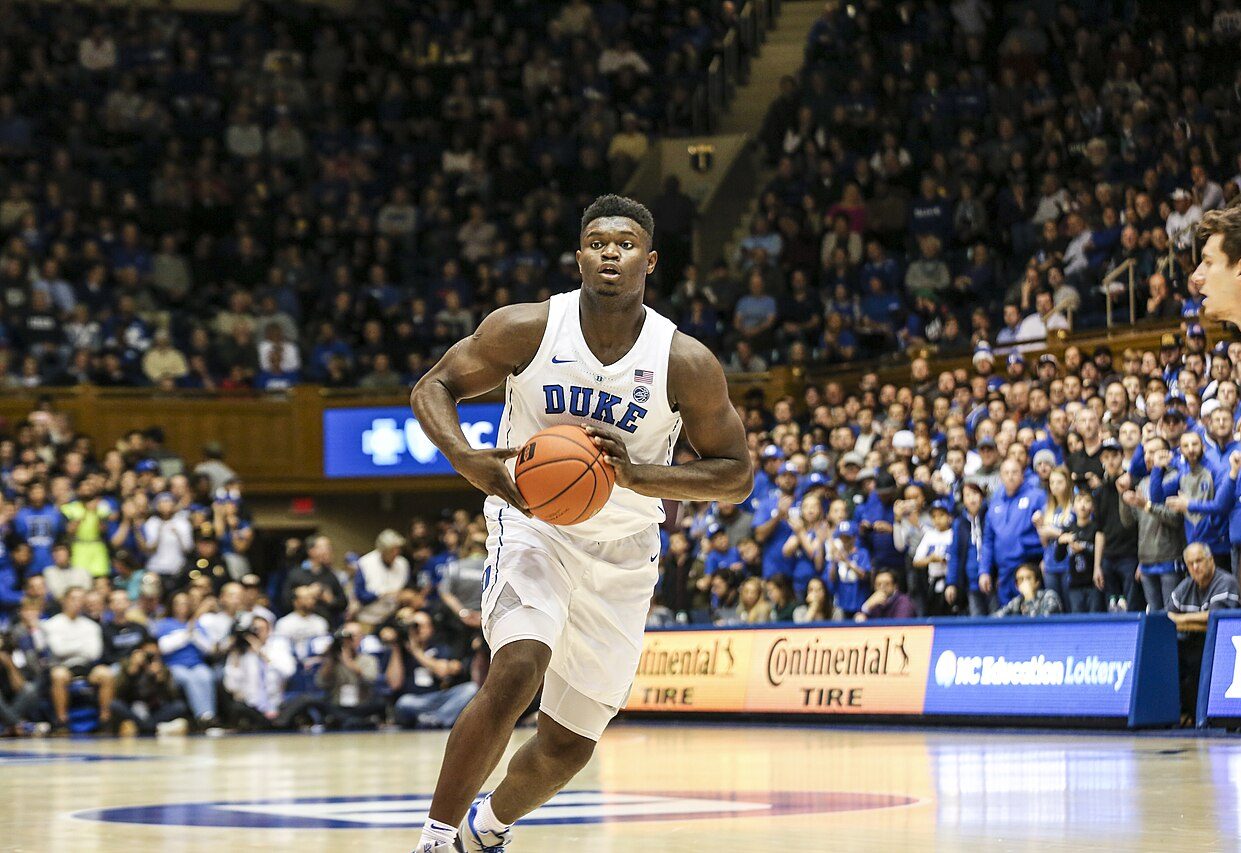
His college career lasted only one season, but it was one of the most heavily watched freshman campaigns in recent memory.
At Duke in 2018-19, Williamson averaged 22.6 points, 8.9 rebounds, 2.1 assists, 2.1 steals and 1.8 blocks while shooting 68.0 percent from the field. Those numbers only tell part of the story. Duke had other elite freshmen, but Williamson was the player who bent games. He finished in traffic, pushed the ball in transition, defended multiple spots and played with an energy that changed the pace of possessions.
The awards followed quickly. He was the consensus national player of the year, a consensus first-team All-American, ACC Player of the Year, ACC Rookie of the Year and ACC Tournament MVP. For one season, college basketball revolved around him.
That year also produced one of the most replayed moments of his amateur career for the wrong reason: the February game against North Carolina in which his shoe tore apart less than a minute after tipoff, leading to a knee sprain. The incident became a national story, partly because of the stage and partly because it showed how much attention followed him by then. He returned for the ACC and NCAA tournaments, and after Duke’s season ended, the next step was obvious.
The first pick and instant expectations in New Orleans
The New Orleans Pelicans selected Williamson first overall in the 2019 NBA Draft. It was a franchise-defining pick, coming just after the Anthony Davis era had closed. New Orleans needed a new centerpiece, and Williamson arrived with both star power and pressure.
He signed his rookie-scale contract in July 2019. Off the court, the business side moved just as fast. He signed with Jordan Brand on a reported multiyear deal widely described as one of the richest shoe agreements ever for a rookie. Endorsements with major national brands followed.
His NBA debut did not come immediately. A torn meniscus in his right knee delayed the start of his rookie season, an early sign of a pattern that would keep resurfacing.
A brilliant start, even in short bursts
When he finally debuted in January 2020, Williamson made an immediate impression. In 24 games as a rookie, he averaged 22.5 points, 6.3 rebounds and 2.1 assists in just under 28 minutes a night, earning All-Rookie First Team honors.
The scoring was forceful but not wild. That stood out right away. He was not just overpowering smaller defenders; he was finishing with touch, changing angles in midair and getting to the rim with startling ease. His field-goal percentage was elite from the start because so much of his offense came in the paint, where his combination of strength and burst was difficult to solve.
Then came his first full statement season. In 2020-21, he played 61 games and averaged 27.0 points, 7.2 rebounds and 3.7 assists while shooting 61.1 percent from the field. He made his first NBA All-Star team and became one of the youngest players ever selected to the game.
That season remains one of the clearest snapshots of what Zion Williamson can be at his best: a high-volume scorer who barely wastes possessions.
Injuries changed the rhythm of his career
The next turn was harsh. Williamson missed the entire 2021-22 season because of a fractured right foot, a major interruption just as his career seemed to be accelerating.
New Orleans still committed to him in the summer of 2022, signing him to a five-year rookie max extension. The deal was reported at $193 million guaranteed, with escalators that could push the total higher. The contract drew extra attention because published reports said it included protections tied to weight and games played. Teams rarely discuss those details publicly, so some specifics have circulated through reporting rather than formal club statements.
He returned in 2022-23 and, when available, again looked like an All-Star. In 29 games, he averaged 26.0 points, 7.0 rebounds and 4.6 assists, earning a second All-Star selection. But another hamstring injury cut the season short.
That pattern, dominance in bursts, then another absence, became central to any honest account of his NBA years.
The healthiest season of his career
For a while, 2023-24 offered a different picture. Williamson played 70 games, the highest total of his career, and averaged 22.9 points, 5.8 rebounds and 5.0 assists. The scoring dipped from his peak seasons, but the broader shape of his game was easier to see over a longer schedule.
He was not just a finisher anymore. He created more as a passer, handled the ball more often and spent stretches functioning as an offensive hub. At 6-foot-6, he has never fit the old template of a back-to-the-basket power forward, and his best work often comes facing up, attacking gaps and forcing help defenders to make impossible choices.
The season ended on a frustrating note when he suffered a hamstring injury during the Play-In Tournament, costing him a chance to continue into the postseason. Even in a year that felt more stable, the physical setbacks did not fully disappear.
Style of play: more than the dunks
The easiest way to describe Williamson is to start with force. He is one of the league’s strongest drivers, and when he gets a shoulder past a defender, the play often feels over. But that description is incomplete.
What makes him special is the speed before the collision and the touch after it. He gets off the floor quickly, changes direction well for his size and finishes with either hand. He has long been listed at 6 feet 6 inches, which is short for a traditional frontcourt scorer, yet he plays bigger because of his frame, timing and explosion.
His efficiency has been the statistical signature of his career. Through his first several NBA seasons, he consistently converted well over half his field-goal attempts, an unusually high mark for a player carrying that much scoring responsibility. Much of that comes from where he operates: the restricted area, transition lanes and hard downhill drives.
Defensively, the picture has been less settled. At his best, he can be disruptive with his quick hands and ability to switch. Over longer stretches, consistency on that end has been harder to maintain.
Life away from the court
Some of the most grounded details in Williamson’s public story come from what he has done in New Orleans beyond basketball.
During the 2020 shutdown, he pledged to cover 30 days of salaries for workers at the Smoothie King Center. It was a practical gesture, and one that resonated locally because it focused on arena staff rather than headlines.
He has also made other documented donations in the area, including support for local schools and community funds. Those efforts have helped shape his image in New Orleans as more than just the franchise’s most famous player.
On a more personal note, Williamson has spoken publicly about his love of anime, once saying it “saved” him during difficult periods. It is a small detail, but it gives his public profile a little texture beyond the usual athlete branding.
Family has remained visible throughout his career as well. His mother and stepfather have long been part of the public record around his development, though much of his private life is best left there unless he addresses it himself.
Rumors, reports and what is actually confirmed
Because Williamson is a star player with an uneven availability record, rumors tend to follow him quickly.
Trade speculation has surfaced more than once in NBA reporting, but unless a move is announced by a team, it remains speculation. The same applies to conflicting reports about whether New Orleans has considered moving him. Those stories belong in the category of reported rumor, not confirmed fact.
There has also been reporting about the structure of his contract and whether future salary protections could be affected by health or conditioning benchmarks. Some outlets, including Forbes, have discussed those possibilities based on reported contract language. Still, unless the team or league formally confirms a specific trigger, it is more accurate to describe those details as reported terms rather than settled public fact.
Reports have also circulated about the future of his signature sneaker line with Jordan Brand. Unless officially announced by the company, that too should be treated as reporting, not confirmation.
One confirmed team matter did arrive late in the 2024-25 season, when the Pelicans suspended Williamson for one game for violating team policies. That was an official disciplinary action, not rumor.
The shape of Zion Williamson’s career so far
Few players have entered the league with more visibility, and few have produced so much offense so efficiently so early. Zion Williamson has been an NBA All-Star twice, a former No. 1 pick, and one of the game’s most unusual interior scorers.
His story, though, is not a straight climb. It is a career of surges and interruptions: high-level production, long absences, renewed momentum, then another setback. That tension is part of the profile now. So is the fact that he has spent his entire NBA career with the New Orleans Pelicans, trying to turn flashes of dominance into something steadier.
When he is on the floor, the appeal is still obvious. There are not many players built like him, and even fewer who move like him.
FAQ
How tall is Zion Williamson?
He is listed at 6 feet 6 inches (1.98 m).
What team does Zion Williamson play for?
He plays for the New Orleans Pelicans.
When was Zion Williamson drafted?
He was selected first overall in the 2019 NBA Draft by New Orleans.
Has Zion Williamson been an NBA All-Star?
Yes. He was named an All-Star in 2021 and 2023.
What position does Zion Williamson play?
He is primarily a power forward, though his offensive role often includes handling the ball and attacking from the perimeter.
What is Zion Williamson known for?
He is known for powerful finishing, explosive leaping, efficient scoring in the paint and his ability to attack defenders off the dribble.
Photo: Keenan Hairston from Raleigh, CC BY-SA 2.0, via Wikimedia Commons