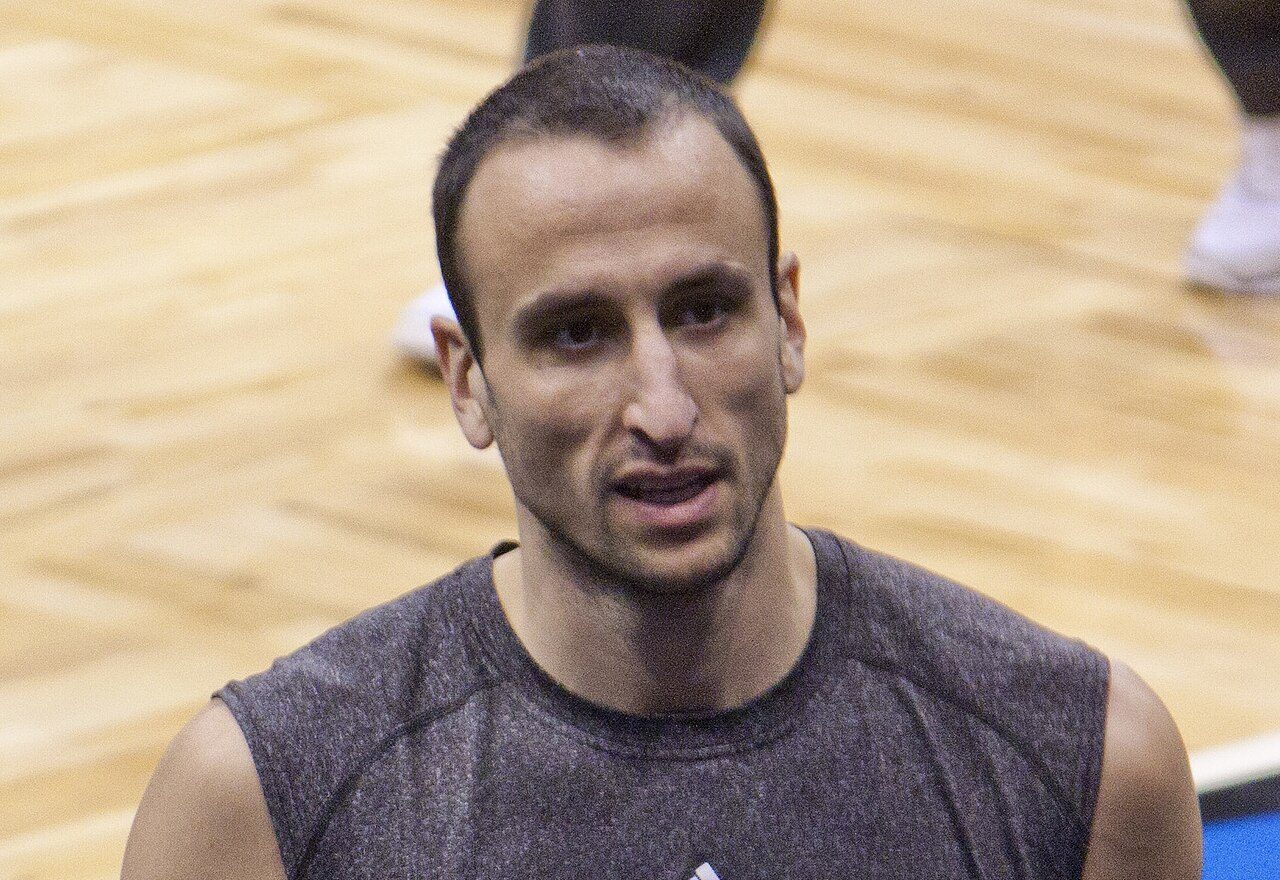
Four NBA titles, an Olympic gold medal, a EuroLeague crown, and a Hall of Fame jacket. Very few careers in basketball connect that many worlds. Manu Ginóbili’s did.
From Bahía Blanca to the pro game
Emanuel David Ginóbili Maccari was born on July 28, 1977, in Bahía Blanca, Argentina, a city with a deep basketball tradition and a habit of producing tough, skilled players. In his case, the game was everywhere. His father, Jorge, coached. His older brothers, Leandro and Sebastián, both played professionally. The sport was less a hobby than part of the household rhythm.
He did not come through the American college system. His path was the one many South American players took at the time: local clubs, early senior minutes, and a gradual climb through Argentina and Europe. That background helped shape the player he became. He learned to read the floor, improvise, and play through contact long before he reached the NBA.
As a boy, he admired Michael Jordan, but Ginóbili never turned into an imitator. What stood out instead was his own style: left-handed, slippery in traffic, creative off the dribble, and willing to try passes or finishes other players would not even see. Later, NBA audiences would come to know him for the Eurostep, a move already familiar in international basketball but one he helped bring into the league’s mainstream.
Early stops in Argentina and a breakthrough in Italy
His professional career began with Andino Sport Club in the mid-1990s. He then played for Estudiantes de Bahía Blanca, staying close to home while sharpening his game against older competition.
The real jump came in Italy. Ginóbili joined Basket Viola Reggio Calabria in 1998 and quickly showed he was more than a prospect. During that stretch, the San Antonio Spurs selected him with the 57th pick in the 1999 NBA Draft, a second-round choice that barely registered at the time outside scouting circles.
San Antonio did not rush him over. That turned out to be important. Instead of arriving in the NBA as an unfinished reserve, he kept developing in Europe and arrived as a polished, battle-tested guard.
From 2000 to 2002, he played for Virtus Bologna, and that is where his reputation changed. In 2001, Virtus won the EuroLeague title and the Italian league championship. Ginóbili was named EuroLeague Finals MVP and also won the Italian League MVP award in 2001 and 2002. Virtus added Italian Cup titles in both seasons, and he was the Italian Cup MVP in 2002.
By the time he left Bologna, he was not simply a draft stash with upside. He was one of the best guards outside the NBA.
San Antonio found something different
When Ginóbili joined the Spurs in 2002, the franchise already had its foundation in place with Tim Duncan, David Robinson, and Gregg Popovich’s demanding structure. What Ginóbili added was unpredictability.
He attacked from odd angles. He drove into crowds and somehow came out with a layup, a foul, or a pass to the corner. He played with risk, and sometimes with chaos, but usually with purpose. On a team known for discipline, he supplied a jolt of invention.
His rookie season ended with a place on the NBA All-Rookie Second Team, and the Spurs won the championship in 2003. That first title came quickly, though Ginóbili was still settling into the league and into Popovich’s trust.
The next two championships told a fuller story. In 2005, he was central to San Antonio’s title run, especially in the Finals against Detroit, where his scoring bursts and downhill pressure changed the shape of the series. Some observers have argued he had a case for Finals MVP; officially, the award went to Duncan, and that remains the record. In 2007, the Spurs won again, with Ginóbili now fully established as one-third of the team’s core alongside Duncan and Tony Parker.
That trio became one of the defining combinations of its era. Duncan gave the Spurs their anchor, Parker their speed, and Ginóbili their edge. Together they set the NBA record for regular-season wins by a trio and later finished with 575 regular-season victories and 126 playoff wins as teammates.
Starter, reserve, closer
One reason Ginóbili’s career stands out is that it never followed the usual star template. He was good enough to start, and often did, but some of his most valuable seasons came when he embraced a bench role that made the Spurs deeper and more dangerous.
That willingness did not reduce his impact. It sharpened it.
In 2007-08, he had the finest NBA season of his career: 19.5 points, 4.8 rebounds, and 4.5 assists per game, plus his usual mix of drives, steals, and momentum-swinging plays. He won NBA Sixth Man of the Year, made the All-NBA Third Team, and finished among the league’s most influential guards despite not fitting neatly into the standard categories of franchise scorer or full-time starter. He made All-NBA Third Team again in 2010-11 and was selected to the All-Star Game in 2005 and 2011.
Across 16 NBA seasons, all with San Antonio, he played 1,057 regular-season games and averaged 13.3 points, 3.5 rebounds, and 3.8 assists. He shot 44.7 percent from the field, 36.9 percent from three, and 82.7 percent at the line. The raw totals only tell part of it. Ginóbili was one of those players whose impact often arrived in bursts: a drawn charge, a left-handed finish, a steal, a pass no one expected.
The fourth championship, in 2014, gave his NBA story a fitting late chapter. By then, the Spurs were older, more precise, and playing some of the best team basketball of the era. They beat Miami in the Finals, and Ginóbili, no longer in his prime but still unmistakably himself, remained part of the machine.
He retired on August 27, 2018, after spending his entire NBA career with one franchise.
Argentina was never a side story
For many players, international basketball sits behind the NBA résumé. For Ginóbili, it belongs right beside it.
He debuted for Argentina’s senior national team in the late 1990s and became one of the key figures in the generation later known as the Golden Generation. The breakthrough came at the 2002 FIBA World Championship in Indianapolis, where Argentina won silver and handed the United States its first loss with NBA players in a major international competition.
Then came Athens.
At the 2004 Olympics, Argentina beat the United States in the semifinals and went on to win the gold medal, one of the most important achievements in the country’s basketball history. Ginóbili was the leading scorer of that tournament and was named the men’s Olympic basketball MVP by FIBA. Argentina added Olympic bronze in 2008, and he also helped the national team win the 2001 FIBA AmeriCup and the 2011 FIBA AmeriCup.
His international résumé includes more than medals. It helped redefine what Argentina could be in men’s basketball. For a player already thriving in the NBA, those performances gave his career a second center of gravity.
The style everyone remembers
Some players are remembered by numbers first. Ginóbili is remembered by movement.
He was listed as a shooting guard and small forward, but he often played like a creator disguised as a wing. He changed pace well, got into the paint, absorbed contact, and made split-second decisions that looked improvised even when they were perfectly timed. His left hand gave defenders one problem; his timing gave them another.
The Eurostep became especially tied to him in the NBA. He did not invent the move, but he popularized it for a wide American audience and used it as a weapon against bigger, more athletic defenders. That influence lasted well beyond his own career.
He also defended with more force than people sometimes remember. Ginóbili took charges, jumped passing lanes, and played with a physical edge that matched the flair in his offensive game.
Life away from the court
Away from basketball, his public image has long centered on family. He married Marianela Orono in 2004. They have twin sons, Dante and Nicola, born in 2010, and another son, Luca, born in 2014.
Ginóbili has spoken at times about how fatherhood changed his perspective, helping him handle the emotional highs and lows of a long season with more balance. It fits the arc of his career: a fiercely competitive player who learned how to sustain that intensity over many years.
One off-court story became part of NBA folklore because it happened on the court. During a game in 2009, a bat flew into the arena in San Antonio. Ginóbili swatted it out of the air with one hand, a moment so strange and so perfectly on-brand that it followed him for the rest of his career.
As for his post-playing life, some details about where he has lived have been reported by real-estate and tracking sites rather than directly confirmed by Ginóbili. Reports have linked him to Los Angeles after retirement, and it is publicly known that he previously owned a home in The Dominion area of San Antonio. Those location details should be treated as reported, not as firmly confirmed personal disclosures.
Estimated net worth figures are also only estimates. Some outlets, including Sportskeeda, have placed Manu Ginóbili’s net worth around $45 million, but such numbers are not official financial records.
Hall of Fame place, without exaggeration
Ginóbili was inducted into the Naismith Memorial Basketball Hall of Fame in 2022, and the case was straightforward. He won at every major level available to him: in Italy, in the NBA, and with Argentina.
His career also remains unusual in a more specific way. He is one of the very few players to win a EuroLeague title, an NBA championship, and an Olympic gold medal. That combination says plenty on its own.
What made him memorable, though, was not just the list of honors. It was the way he played. He could look reckless and precise in the same possession. He fit into a dynasty without losing his own identity. And for a second-round pick from Bahía Blanca, that is a rare basketball life.
FAQ
How many NBA championships did Manu Ginóbili win?
He won four NBA titles with the San Antonio Spurs: 2003, 2005, 2007, and 2014.
When did Manu Ginóbili retire?
He announced his retirement on August 27, 2018.
What is Manu Ginóbili’s nationality?
He is Argentine and also holds Italian citizenship.
What position did Manu Ginóbili play?
He was primarily a shooting guard, though he also spent time at small forward and often functioned as a secondary playmaker.
Did Manu Ginóbili win Olympic gold?
Yes. He helped Argentina win the gold medal at the 2004 Athens Olympics.
Is Manu Ginóbili in the Hall of Fame?
Yes. He was inducted into the Naismith Memorial Basketball Hall of Fame in 2022.
Photo: Mike, CC BY-SA 2.0, via Wikimedia Commons