
One shot still sits near the center of Dimitris Diamantidis’s story: the late three against France in the EuroBasket 2005 semifinal, a calm release in a frantic moment that sent Greece to the final. It was a fitting image for a player who rarely chased attention but kept deciding big possessions anyway.
Diamantidis built his entire professional career in Greece, first with Iraklis Thessaloniki and then with Panathinaikos, where he became the organizing force behind one of the most successful runs in European club basketball. At 1.96 meters, with the size to see over defenses and the reach to disrupt them, he was never easy to place in one box. He handled like a point guard, defended across positions, and often controlled a game without needing to dominate the scoring.
Born on May 6, 1980, in Kastoria, Greece, Dimitrios “Dimitris” Diamantidis grew up far from the NBA pipeline that shapes so many modern stars. He started playing with AS Kastoria as a teenager, and local observers quickly noticed the all-around quality in his game. He was reportedly nicknamed “Kukoc” in his youth, a reference to Toni Kukoc and to the versatility people already saw in him.
From Kastoria to Iraklis
His path was distinctly Greek. There was no college stop, no move abroad, and no early detour through another system. After developing in Kastoria, he moved into senior basketball and joined Iraklis Thessaloniki in 1999.
Those five seasons, from 1999 to 2004, were where the outline of his game became clear. He was not a guard built around shot volume. Even early on, he rebounded well for his position, passed instinctively, defended passing lanes, and played with unusual patience. In the 2001-02 Greek League season, he averaged 6.2 points, 4.7 rebounds, 2.8 assists, and 1.5 steals per game for Iraklis, numbers that already hinted at the breadth of his impact.
By the end of his time there, he had grown from a promising multi-tool guard into one of the league’s most influential players. He was named Greek League MVP in 2004, a major marker before the biggest move of his club career.
Panathinaikos and the years of control
In 2004, Diamantidis signed with Panathinaikos. He stayed until his retirement in 2016, and those seasons turned him into one of the defining figures of the EuroLeague era.
The trophy list is substantial, but it matters because it tracks the shape of his influence. With Panathinaikos, he won three EuroLeague titles, in 2007, 2009, and 2011. He also won nine Greek League championships and 10 Greek Cups. The club completed the Triple Crown in 2007 and 2009, winning the EuroLeague, domestic league, and domestic cup in the same season.
What stood out was the way he led. Panathinaikos did not rely on him as a pure scorer. Instead, he managed pace, found angles others missed, defended the opponent’s best creators, and made late-game decisions with very little waste. He could run the offense as a point guard, slide off the ball, or function almost like a point forward when matchups demanded it.
That blend of size, vision, and defensive timing earned him several nicknames, including “3D,” “The Octopus,” and “Spiderman.” None of them were really about flair. They were about reach, anticipation, and the sense that he was always touching the game.
The peak: 2011 and a rare kind of dominance
His most complete season came in 2010-11. Panathinaikos won the EuroLeague, and Diamantidis was named EuroLeague MVP, EuroLeague Final Four MVP, and EuroLeague Best Defender. He remains the only player to collect all three honors in the same season.
That year did not come out of nowhere. He had already been recognized repeatedly across Europe. He won the EuroLeague Best Defender award six times: 2005, 2006, 2007, 2008, 2009, and 2011. He made the All-EuroLeague First Team four times, in 2007, 2011, 2012, and 2013. In Greece, he was named Greek League MVP six times: 2004, 2006, 2007, 2008, 2011, and 2014.
The awards help explain the player, but they do not fully capture his style. Diamantidis could finish a game with modest scoring numbers and still feel like the central figure in it. He controlled possessions. He erased mistakes. He made teammates easier to play with.
Records that matched the reputation
By the time he stepped away, his place in EuroLeague history was secure. He retired as the competition’s all-time leader in assists and steals, and he also finished his career as the all-time leader in Performance Index Rating under the modern EuroLeague format. On October 30, 2014, he became the first player in EuroLeague history to reach 1,000 career assists.
His career EuroLeague averages, 9.5 points, 4.5 assists, 3.8 rebounds, and 1.6 steals per game, reflect the same pattern seen throughout his career. He did a little of everything, and usually the hardest things. He was named to both the EuroLeague 2000-2010 All-Decade Team and the EuroLeague 2010-2020 All-Decade Team, a rare bridge between two eras. In 2016, EuroLeague named him a Legend.
Late in his Panathinaikos run, his role changed but his value did not disappear. In his final EuroLeague season, 2015-16, he averaged 8.2 points, 5.8 assists, 2.7 rebounds, and 1.0 steals per game. After the 2015-16 season, he retired from club basketball. Panathinaikos later retired his No. 13 jersey.
Greece, France, and the national-team years
His senior debut for Greece came at the 2004 Athens Olympics, but his international résumé had started earlier with youth and developmental teams, including the 2000 FIBA Europe Under-20 Championship and the 2001 Mediterranean Games, where Greece won silver.
The national-team years brought some of the defining moments of his career. He played at EuroBasket 2003, 2005, and 2007; the Olympic Games in 2004 and 2008; and the FIBA World Championships in 2006 and 2010.
The high point was EuroBasket 2005. Greece won gold, and Diamantidis made the All-Tournament Team. In the semifinal against France, with Greece trailing late, he hit the go-ahead three-pointer that remains one of the most replayed shots in modern Greek basketball.
A year later, Greece reached the final of the 2006 FIBA World Championship and won silver after beating the United States in the semifinal. That run fueled years of discussion about whether Diamantidis could have played in the NBA. Those conversations were real, but they never became a move. He went undrafted and spent his full professional career in Greece.
He retired from the Greek national team in September 2010.
Why his game aged so well
Some guards depend on speed first and feel second. Diamantidis was the other way around. His advantages were reading the floor, understanding timing, and using his frame to make every pass and dribble more difficult for the opponent.
At 6-foot-5, he could defend point guards, many shooting guards, and some wings. His reported 2.16-meter wingspan has long been part of the story around him, though that figure is often cited informally rather than through official measurement. What is beyond dispute is the effect it had. He crowded ball handlers, tipped passes, recovered into plays that looked finished, and made offenses work deeper into the shot clock.
Offensively, he was unselfish almost to a fault, but not passive. He could throw skip passes with either hand, hit cutters in traffic, and punish defenders who went under screens. In late-clock situations, he was also capable of making the shot himself, which is one reason he remained so difficult to scheme against.
His long rivalry with Vassilis Spanoulis, especially in Panathinaikos-Olympiacos games, helped define an era in Greek basketball. It was a rivalry built on contrast as much as conflict: Spanoulis the attacking scorer, Diamantidis the controller and stopper.
Life away from the court
Off the floor, Diamantidis has generally kept a low public profile, which fits the way he played. He is married to Verina Chioti, and published reports in Greece have noted that the couple married in 2012 and have a daughter. Because he has remained private, most personal details beyond that have stayed largely out of view.
A few details do stand out. He has been linked closely with his hometown throughout his career, and the main indoor hall in Kastoria bears his name. He also once said that he supported PAOK as a child, a small but revealing note in a career otherwise tied to Panathinaikos green.
His bond with coach Zeljko Obradovic became one of the central relationships of his career. Obradovic, who coached many elite European players, spoke glowingly about Diamantidis more than once. The praise carried weight because it came from someone who valued decision-making and discipline as much as talent.
Retirement did not end his connection to Panathinaikos. He has served the club in an executive advisory role, extending a relationship that had already lasted more than a decade on the floor.
FAQ
When was Dimitris Diamantidis born?
He was born on May 6, 1980, in Kastoria, Greece.
Did Dimitris Diamantidis play in the NBA?
No. He went undrafted and spent his entire professional career in Greece.
How many EuroLeague titles did he win?
He won three EuroLeague titles with Panathinaikos: 2007, 2009, and 2011.
What position did Dimitris Diamantidis play?
He was primarily a point guard, but he also played as a shooting guard and point forward because of his size and passing ability.
Why is Dimitris Diamantidis known as such a great defender?
He won the EuroLeague Best Defender award six times and retired as the EuroLeague’s all-time steals leader.
What number did he wear for Panathinaikos?
He wore No. 13, and Panathinaikos retired the jersey after his playing career ended.
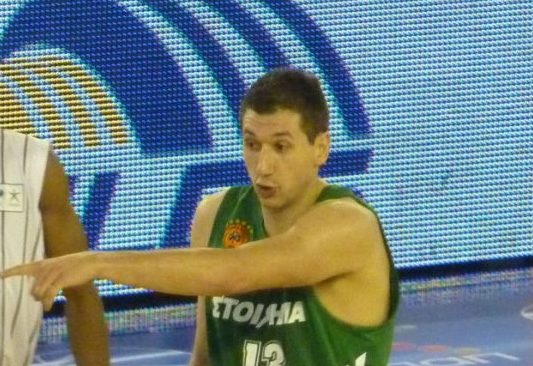
Photo: Enpatrais (όνομα χρήστη στη Βικιπαίδεια) / Enpatrais at…, CC BY-SA 4.0, via Wikimedia Commons