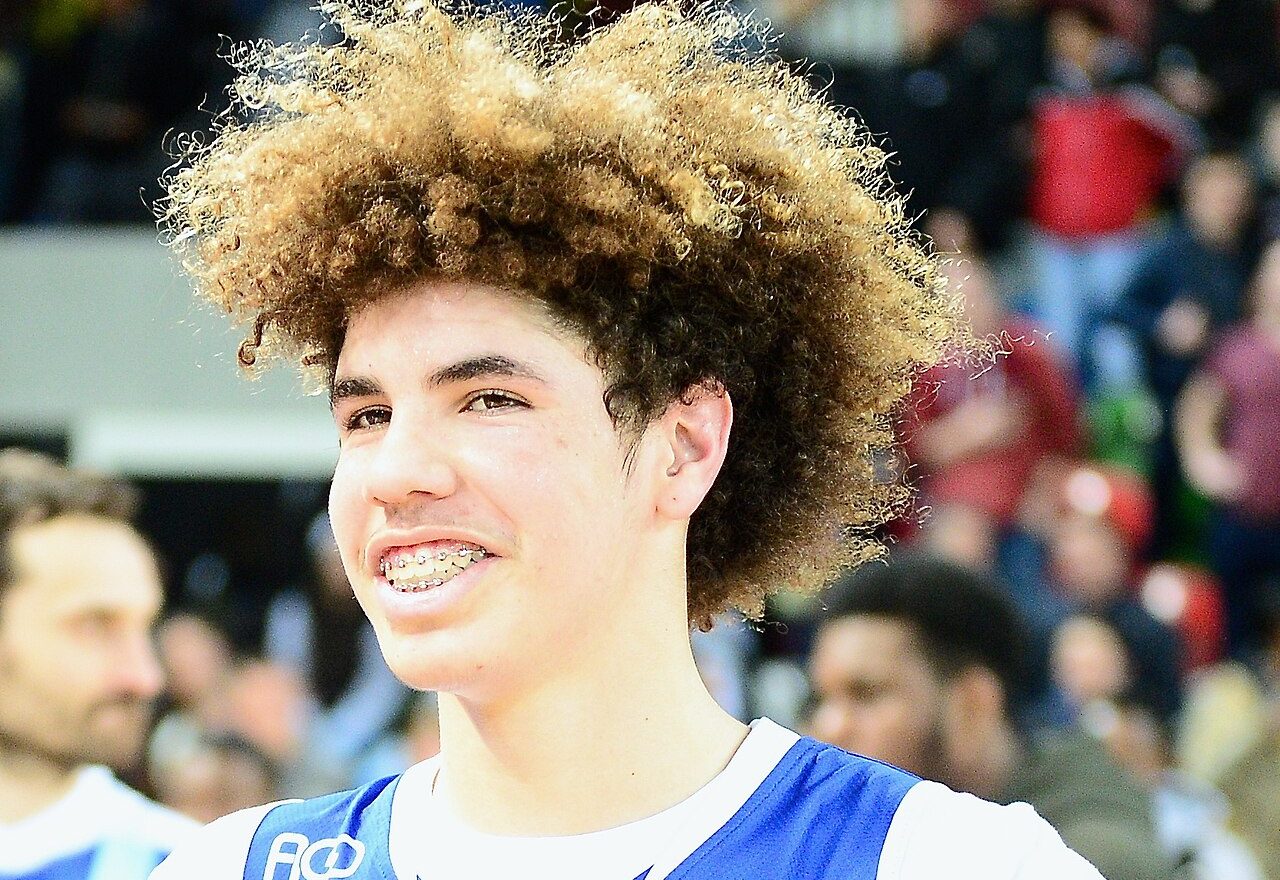
Ninety-two points in a high school game will do that: it turns a prospect into a headline. Long before LaMelo Ball heard his name called in the NBA draft, he was already one of the most watched young guards in basketball, a 6-foot-7 playmaker with flair, range and a path that kept swerving away from the usual route.
Born on August 22, 2001, in Anaheim, California, Ball grew up in a household where basketball was constant. He is the youngest son of LaVar and Tina Ball, and the younger brother of Lonzo and LiAngelo. Games, workouts and cameras all arrived early. So did expectations.
What made him different, even as a kid, was the combination of size and imagination. He handled the ball like a small guard, but he could see the floor over defenders. That mix would shape every stop that followed, from Southern California to Lithuania, Australia and eventually the NBA.
Chino Hills, family attention and a very public rise
Ball’s first big stage was Chino Hills High School, where he played alongside his brothers on a team that drew national attention. Chino Hills won a state title during that era, and the family became one of the most discussed stories in youth basketball.
Then came the game people still mention first. On February 7, 2017, Ball scored 92 points against Los Osos High School, one of the highest single-game totals in California high school history. It was a startling number, but it also fit the player he was becoming: fearless, creative and willing to shoot from almost anywhere.
His high school years did not follow a smooth, traditional line. Ball left Chino Hills before his junior season amid a family dispute with the coaching staff. Instead of settling into the standard college-prep track, he moved into a far less predictable basketball life. He later attended SPIRE Academy in Ohio, but by then the usual NCAA path was no longer the center of the plan.
Lithuania, the JBA and a detour that kept him in view
Rather than play college basketball, Ball went overseas. In late 2017, he signed with Prienai in Lithuania and spent part of the 2017-18 season there. The numbers were modest, and the experience was uneven, but it mattered. It was his first taste of professional basketball, with older players, different styles and little of the structure that usually cushions elite American prospects.
His time in Lithuania also ended noisily. Ball and his family left the club after public criticism from LaVar Ball about his son’s role and playing time. That episode added to the attention surrounding him, though it also reinforced something that would follow him into the NBA: his career was never going to unfold quietly.
He then played in the Junior Basketball Association, the short-lived league launched by his father. With the Los Angeles Ballers, he stayed active, put up numbers and remained in the spotlight. The competition sat outside the main development pipeline, but the stretch kept his name circulating while he continued to refine his game.
Australia became the real turning point
The stop that most changed how NBA teams viewed him came in Australia. Ball joined the Illawarra Hawks for the 2019-20 NBL season, choosing a professional league with stronger competition and clearer scouting value than the alternatives he had tried before.
That decision paid off. In 12 games, he averaged 17.0 points, 7.6 rebounds and 6.8 assists before a foot injury ended his season early. He recorded a triple-double in the NBL, flashed advanced passing reads in traffic and showed that his style could translate against professionals. He was named NBL Rookie of the Year, and by then the outline of his NBA identity was easy to see.
He was tall for a point guard, loose with the dribble in a useful way rather than a reckless one, and gifted at throwing passes that most players never even attempt. Scouts still debated his shot selection and defensive consistency, but the talent was obvious.
Draft night and an immediate impact in Charlotte
On November 18, 2020, the Charlotte Hornets selected Ball with the third overall pick in the NBA Draft. It was a significant family milestone too: he and Lonzo became the first brothers in NBA history to both be drafted in the top three.
Charlotte signed him to the standard rookie-scale contract, and he did not need long to justify the pick. Ball came off the bench at first, then steadily forced a larger role with his pace, rebounding and passing. On January 9, 2021, he became the youngest player in NBA history at the time to record a triple-double, finishing with 22 points, 12 rebounds and 11 assists against Atlanta.
That rookie season ended with hardware. Ball won NBA Rookie of the Year and earned All-Rookie First Team honors after averaging 15.7 points, 6.1 assists and 5.9 rebounds per game. More than the numbers, Charlotte had found an offensive organizer who could speed up the game without making it feel rushed.
All-Star recognition and the challenge of staying on the floor
His second season brought another step. Ball was named an NBA All-Star, becoming one of the league’s youngest featured guards. He averaged 20.1 points, 7.6 assists and 6.7 rebounds that season, and Charlotte’s offense often ran to the rhythm he created: hit-ahead passes, deep pull-up threes, quick decisions in transition.
From there, the story became more complicated. The talent remained clear, but injuries began to interrupt his momentum. Ankle problems in particular limited his availability over multiple seasons. When he played, the numbers stayed strong. When he was out, Charlotte lost much of its offensive shape.
In July 2023, the Hornets committed to him with a five-year maximum rookie extension. The deal reflected what he already was when healthy: the franchise’s lead creator and one of the NBA’s more unusual guards, not because he fit the classic point guard mold, but because he stretched it.
Across his time in Charlotte, Ball developed into a high-usage playmaker who could score in bunches, rebound his position and generate easy baskets for teammates. His best stretches combined volume scoring with improvisational passing, the kind of style that can look casual until the defense realizes it is already behind the play.
About the reported move to Minnesota
The source text states that LaMelo Ball plays for the Minnesota Timberwolves. That claim does not match the established public record available through his NBA career to this point. Ball was drafted by Charlotte in 2020 and signed a five-year extension with the Hornets in 2023. Without a confirmed, widely documented trade or signing from reliable league sources, it should not be presented as fact.
So the accurate version is simpler: LaMelo Ball is best documented as a Charlotte Hornets guard, and any claim that he joined Minnesota should be treated as unconfirmed unless backed by official NBA or team reporting.
What makes LaMelo Ball different
At his best, Ball controls a game with timing more than force. He is listed at 6-foot-7, which gives him an unusual passing window for a point guard. He can throw over traps, skip the ball to weak-side shooters and hit cutters without needing a perfect angle.
His handle is similarly distinctive. It is not tidy in the traditional sense, but it is deceptive and elastic, built to shift defenders and open passing lanes. That style can produce turnovers, and there are possessions when the risk outweighs the reward. But it is also what makes him dangerous. Defenses have to account for the possibility that a routine half-court set might suddenly turn into a lob, a cross-court dart or a pull-up three from well beyond the arc.
Scoring has become a bigger part of his game over time. Early in his career, he was often discussed first as a passer. In the NBA, he has shown he can carry real scoring volume too, especially when defenders go under screens or give him space to rise into jumpers.
Off the court: family, business and public attention
Away from basketball, Ball remains tied to one of the sport’s most recognizable families. That has been true since his teenage years, and it has shaped the way his career is covered. Public interest in him has rarely been limited to box scores.
He signed with Puma before entering the NBA, giving him an early signature-brand platform outside the family’s Big Baller Brand orbit. Some outlets have reported that the long-term deal was worth around $100 million, but the exact figure has been disputed publicly and should be treated as reported, not confirmed.
Ball has also been linked to business ventures beyond shoes, including reported involvement with the sports streaming platform Buzzer. As with many athlete investments, the broad association has been public, while the exact size and structure of any stake have not always been fully detailed.
One well-documented gesture came after his season in Australia, when he pledged support for wildfire relief there. It was a meaningful connection to a place that had helped reshape his basketball reputation.
His private life tends to generate online speculation, but that area needs careful handling. Ball has been romantically linked in entertainment and celebrity coverage, including reports connecting him with model Analicia Chaves. Those reports should be treated as public speculation or tabloid-style linkage unless Ball or a clearly reliable source confirms more.
As for net worth figures and property claims, those numbers often vary by outlet and are rarely verified in full public detail. They can be mentioned only as estimates, not settled fact.
FAQ
When was LaMelo Ball drafted?
He was selected by the Charlotte Hornets with the No. 3 pick in the 2020 NBA Draft on November 18, 2020.
Did LaMelo Ball win Rookie of the Year?
Yes. He won the NBA Rookie of the Year award for the 2020-21 season.
How tall is LaMelo Ball?
LaMelo Ball is listed at 6 feet 7 inches, or 2.01 meters.
Has LaMelo Ball been an NBA All-Star?
Yes. He was named an NBA All-Star during the 2021-22 season.
What team does LaMelo Ball play for?
Reliable public records clearly place him with the Charlotte Hornets. Claims that he plays for the Minnesota Timberwolves should be treated as unconfirmed unless supported by official reporting.
What is LaMelo Ball known for as a player?
He is best known for his size at point guard, advanced passing vision, open-floor creativity and deep shooting range.
Photo: Graham Hodges, CC BY 2.0, via Wikimedia Commons