
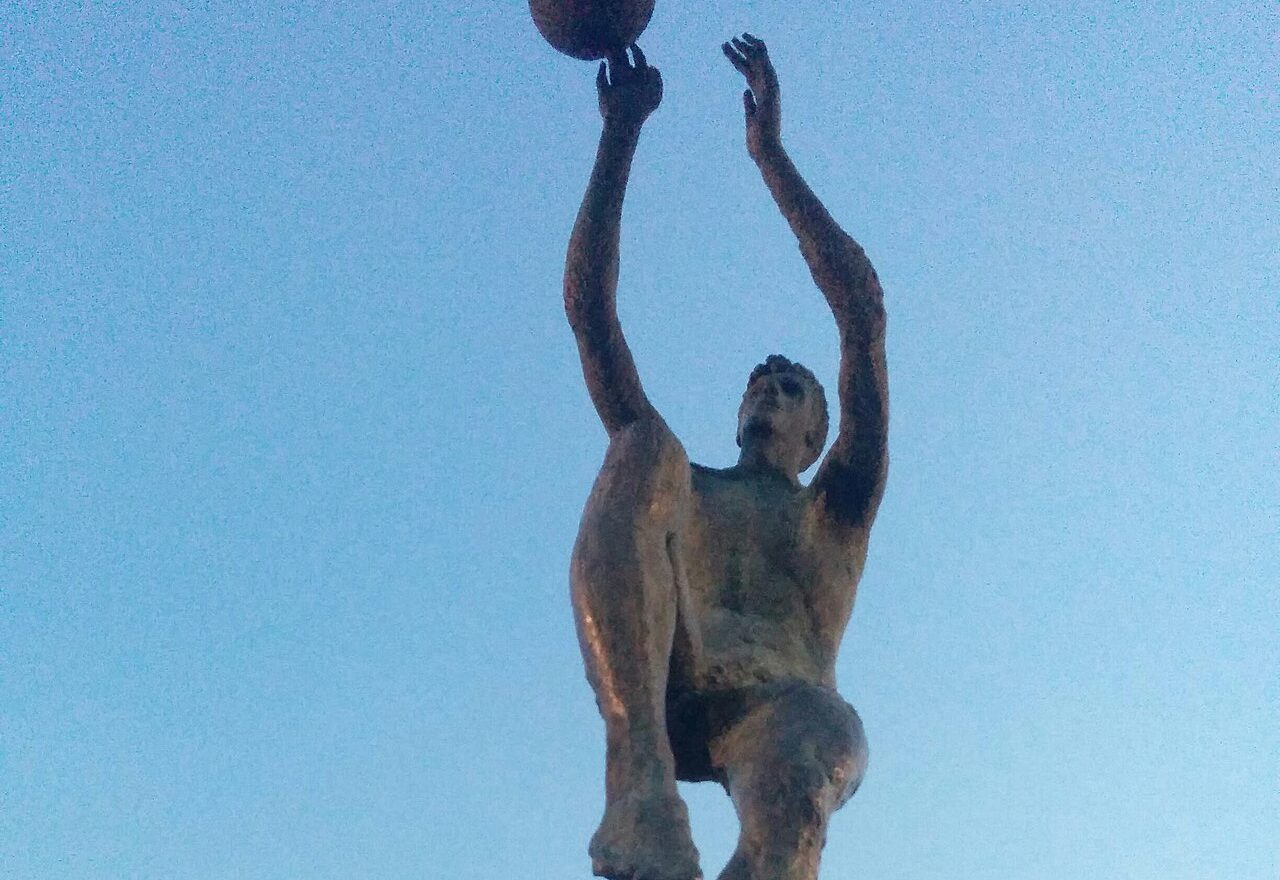
A 22-point NBA season was only the final chapter. Long before New Jersey, before the All-NBA nod, before American fans fully caught up, Dražen Petrović had already spent the better part of a decade turning European scoreboards into personal property.
Born on October 22, 1964, in Šibenik, then part of SR Croatia in Yugoslavia, Petrović grew up in a basketball family and moved fast. He came through the local club Šibenka and was already playing senior basketball as a teenager. By the time most guards are still learning how to run a team, he was already carrying one.
That early rise showed up in the numbers. In the Yugoslav First Federal League, he averaged 16.3 points per game in 1981-82, then 24.5 the following season. The production mattered, but so did the manner of it. He played with urgency, shot without hesitation, and worked with a seriousness that became part of his reputation everywhere he went.
From Šibenik to Cibona, and from prospect to phenomenon
The move to Cibona Zagreb in 1984 changed the scale of his career. Yugoslavia already had one of the strongest domestic leagues in Europe, and Cibona gave him a bigger stage without asking him to change who he was.
He did what scorers do when the lights get brighter: he scored more.
In the 1984-85 league season, Petrović averaged 32.5 points per game in 27 games as Cibona won the Yugoslav league and cup. Then came the European breakthrough. Cibona won the European Champions Cup, now known as the EuroLeague, in 1985 and repeated in 1986, with Petrović at the center of both runs. In 1985-86, his league average climbed to 41.4 points across 30 games.
Those were not one-off explosions. He kept piling up points year after year: 37.3 per game in 1986-87 and 35.8 in 1987-88. Cibona also won the FIBA Cup Winners’ Cup, later known as the Saporta Cup, in 1987, and added more domestic cup success along the way.
One game became part of basketball folklore. In 1985, playing for Cibona in the Croatian republic league, Petrović scored 112 points against Olimpija. Even in a career full of absurd scoring nights, that one still stands out.
The honors followed naturally. He was named MVP of the 1986 FIBA World Championship, won the Euroscar in 1986, and took the Mr. Europa award the same year. He was also named Yugoslavia’s athlete of the year in 1985. Notre Dame reportedly tried to recruit him earlier in the decade, but his path stayed in Europe, where he was already becoming too big for the usual timetable.
Real Madrid: one season, lasting imprint
In 1988, Petrović joined Real Madrid and spent just one season in Spain. It was enough.
He averaged 28.5 points per game in Liga ACB and led the league in scoring. Including playoffs, he put up 28.2 points across 47 games. Real Madrid won the 1989 Copa del Rey and the FIBA Saporta Cup, and Petrović delivered one of the defining performances of his club career in the European final, scoring 62 points against Snaidero Caserta.
That season sharpened his image even further: not just a prolific guard in Yugoslavia, but a scorer who could dominate at the highest club level anywhere in Europe. He was also named MVP of EuroBasket 1989 and won another Euroscar.
His exit from Madrid was abrupt. Reports at the time said he paid a significant buyout to leave for the NBA, often cited at around $1.5 million, though such figures are not always documented uniformly in later retellings. What is clear is that he was determined to go.
Portland: a hard landing in the NBA
The Portland Trail Blazers had drafted him in 1986, taking him in the third round, 60th overall. He did not arrive immediately, and when he finally joined the team for the 1989-90 season, the fit was uneasy.
Portland was good, deep, and not built around him. Petrović averaged 7.6 points in 77 games as a rookie and often played limited minutes behind established guards. In 1990-91, before a midseason trade, he appeared in 18 games and averaged 4.4 points.
For a player used to controlling tempo and volume, it was a jarring adjustment. But the Portland stretch matters because it tested a part of his game that Europe had rarely forced into view: patience. He did not stop pushing. He simply waited for a team that would let him play through mistakes and rhythm.
New Jersey gave him the runway
That team was the New Jersey Nets.
Portland traded Petrović to the Nets in January 1991 as part of a three-team deal. Once he landed there, the story changed quickly. He averaged 12.6 points in 43 games for New Jersey in the second half of the 1990-91 season, then broke through fully in 1991-92 with 20.6 points per game while playing all 82 games.
His final NBA season was his best. In 1992-93, he averaged 22.3 points, 2.7 assists, and 2.3 rebounds in 70 games, shot 51.8 percent from the field, 44.9 percent from three, and 87.0 percent from the line, and made All-NBA Third Team.
Those numbers still read cleanly because they were clean. Petrović was not a high-volume gunner living on difficult shots alone. He was efficient, quick into his release, dangerous off movement, and comfortable attacking a closeout after defenders overplayed the jumper. Across 290 NBA games, he averaged 15.4 points, 2.3 rebounds, and 2.4 assists while shooting 50.6 percent from the field, 43.7 percent from three, and 84.1 percent at the line.
That three-point mark remains among the best of his era, and it helps explain why his NBA rise still feels important in hindsight. He was one of the clearest early proofs that a European guard could arrive with real skill, adapt to the league’s pace and physicality, and become a top scorer rather than a curiosity.
The Nets retired his No. 3 jersey later in 1993.
The international stage was never too big
Before he became an NBA name, Petrović had already built a major career with the national team.
He played for Yugoslavia at the 1984 and 1988 Olympics, winning bronze and silver, then led Croatia to silver at the 1992 Barcelona Olympics. He also represented Yugoslavia at the FIBA World Championships in 1986 and 1990, winning bronze and then gold. At EuroBasket, he played in 1983, 1985, 1987, and 1989, taking bronze in 1987 and gold in 1989.
The medal list is long, but the larger point is simple: he produced in every setting. Junior events, university competitions, senior tournaments, club finals, NBA arenas. The context changed; the output rarely did.
His move from representing Yugoslavia to representing Croatia reflected the political breakup of the region. One of the most discussed personal consequences was the rupture in his friendship with Vlade Divac, a subject both men addressed publicly in different ways over time. It remains part of the story around Petrović, but it should be understood within the much larger trauma of the Yugoslav wars rather than reduced to a simple personal dispute.
Why his game translated
Petrović was often called the “Mozart of Basketball,” a nickname that stuck because his game combined structure and aggression. He could shoot off the catch, pull up off the dribble, run pick-and-roll, and make the extra pass. At 6-foot-5, he had enough size for either guard spot, though he did his best work as a shooting guard with the ball finding him early and often.
What separated him from many scorers was the relentlessness behind the skill. Teammates and opponents alike described his work habits as obsessive. He practiced hard, played angry, and treated every possession as if it needed to be won. In Europe, that drive made him overwhelming. In the NBA, once he found the right role, it made him dangerous every night.
Off the court: family, memory, and the life around the game
His family remained closely tied to his public story. His parents were Jovan and Biserka Petrović, and his older brother Aleksandar Petrović also became a prominent basketball figure as a player and coach.
Some accounts have described Dejan Bodiroga as a relative, but that claim is not reliably established in major biographical sources and is best left unconfirmed.
Away from the floor, Petrović had interests beyond the daily routine of games and travel. He owned a café-bar called Amadeus at Cibona’s arena, a detail that fits the image many friends and teammates described: intensely committed to basketball, but also deeply connected to the places and people around him.
His life ended on June 7, 1993, in a car accident on the Autobahn near Denkendorf, Germany. He was a passenger in a car driven by Klara Szalantzy, to whom he was romantically linked in published reports from the time. Contemporary reporting also stated that Petrović was not wearing a seatbelt.
In the months and years that followed, the tributes kept coming. Goran Ivanišević dedicated his Wimbledon title to him. Zagreb later opened the Dražen Petrović Museum and Memorial Center. The Hall of Fame followed too: Naismith Memorial Basketball Hall of Fame in 2002, FIBA Hall of Fame in 2007.
There were also reports about what might have come next. Some outlets, including World of Basketball, later reported that Panathinaikos had discussed signing him and that Houston Rockets coach Rudy Tomjanovich had interest in bringing him to Houston. Those reports remain part of the conversation around his final months, but they belong in the category of reported plans, not settled fact.
The legacy he left behind
Petrović’s résumé is easy to list: two European Champions Cups with Cibona, a Saporta Cup with Cibona, another with Real Madrid, domestic titles in Yugoslavia and Spain, Olympic medals, a world title, EuroBasket gold, Euroscar awards, and an All-NBA selection.
But the legacy is bigger than the list. Dražen Petrović helped change how basketball people in the United States viewed elite European guards. He arrived from a system many still underestimated, endured a difficult NBA start, and forced his way into recognition through production that could not be dismissed.
That is why his story still holds. Not because it ended early, though it did. Because at every stop before that, he kept proving the same point: the game traveled with him.
FAQ
When did Dražen Petrović die?
He died on June 7, 1993, in a car accident in Germany.
What teams did Dražen Petrović play for?
He played for Šibenka, Cibona Zagreb, Real Madrid, the Portland Trail Blazers, and the New Jersey Nets.
What was Dražen Petrović’s best NBA season?
His best NBA season was 1992-93, when he averaged 22.3 points per game and made All-NBA Third Team.
Did Dražen Petrović win Olympic medals?
Yes. He won bronze with Yugoslavia in 1984, silver with Yugoslavia in 1988, and silver with Croatia in 1992.
Was Dražen Petrović in the Hall of Fame?
Yes. He was inducted into the Naismith Memorial Basketball Hall of Fame in 2002 and the FIBA Hall of Fame in 2007.
Why is Dražen Petrović so important in basketball history?
He was one of the first European guards to become a high-level NBA scorer and helped open the door for later international stars.
Photo: Javier Leiva from Vic, Barcelona, CC BY 2.0, via Wikimedia Commons