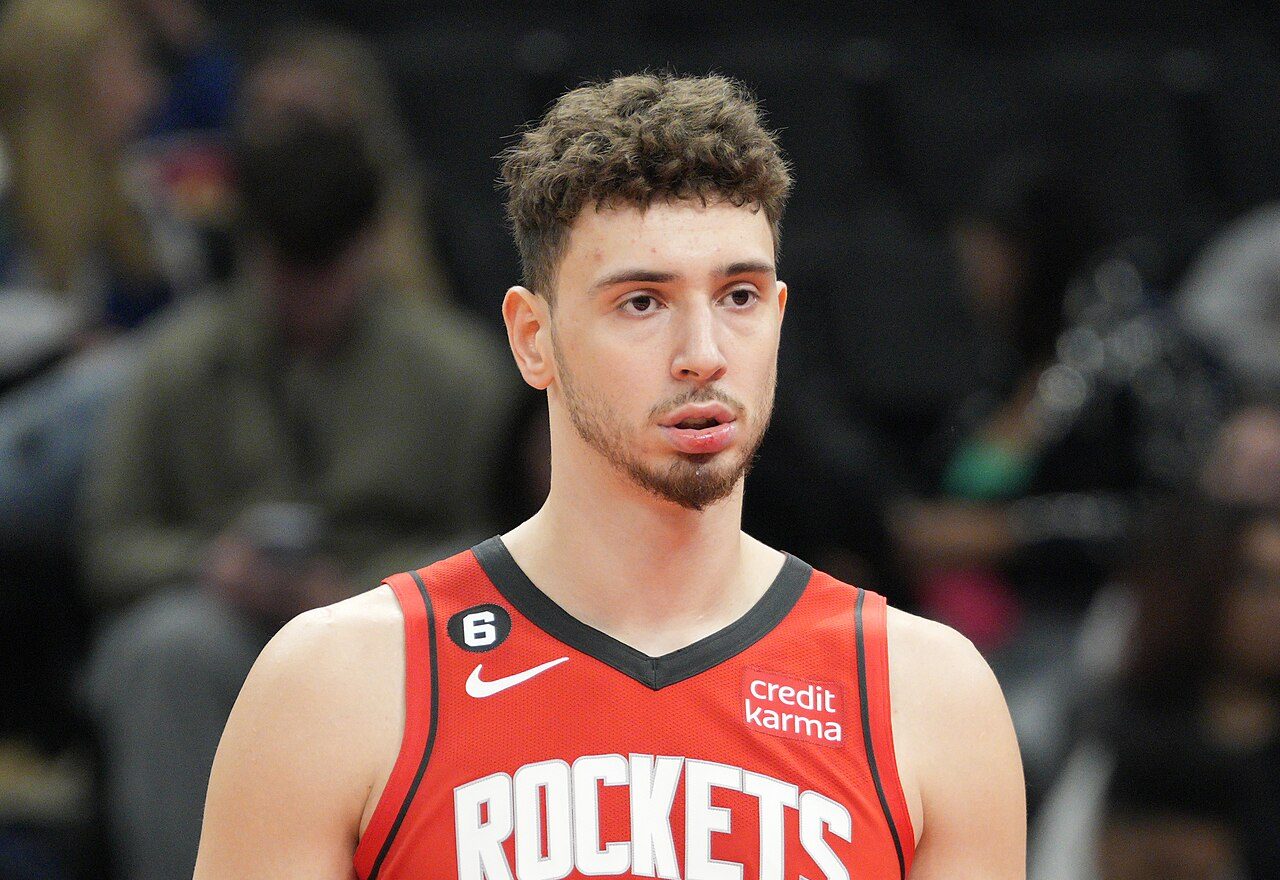
A teenage big man winning MVP in Turkey is rare enough. Doing it before the NBA draft, then turning into the creative center of the Houston Rockets, is what made Alperen Şengün such an unusual prospect from the start.
From Giresun to Turkey’s pro ranks
Şengün was born on July 25, 2002, in Giresun, on Turkey’s Black Sea coast. At home, the first plan for him was not basketball. His parents, Kemal and Ayşe Şengün, reportedly preferred swimming when he was young. Basketball took over anyway, helped along by a simple family influence: he started following his older brother into the game and began playing at around eight years old.
One of the early turning points came when coach Ahmet Gürgen noticed him at a youth sports festival. From there, his development became more structured. He spent time in youth programs in Giresun before moving into Banvit’s system, one of the better-known development pipelines in Turkish basketball.
The outline of his game showed up early. He was a big man, but not the stand-still kind. He had soft touch, nimble feet around the rim, and an instinct for passing that stood out long before he reached the senior level. In 2019, he was named Turkish Basketball Youth League MVP, a sign that he was already separating himself from his age group.
His youth national-team résumé grew at the same time. He made the All-Tournament Team at the 2018 FIBA U16 European Championship, where Turkey won bronze, and again at the 2019 FIBA U18 European Championship, where Turkey finished with silver.
The season that changed everything
Şengün’s first professional season came with Bandırma Kırmızı in the Turkish second division in 2018-19. He played 29 games and averaged 10.8 points, 6.8 rebounds and 1.2 assists. For a teenager, those were not empty developmental minutes. He was productive, physical enough to hold his ground, and clearly ahead of schedule.
He then moved up to Teksüt Bandırma for the 2019-20 season in the Turkish Super League. His role was smaller there, and the numbers reflected it: 5.0 points and 3.9 rebounds in 22 league games. But that year mattered because it put him against stronger, older competition.
Then came Beşiktaş in 2020-21, the season that pushed him onto every NBA scout’s radar. In 34 Turkish Super League games, he averaged 18.6 points, 8.9 rebounds, 2.7 assists, 1.3 steals and 1.5 blocks while shooting efficiently inside. He was named Turkish Super League MVP, becoming the youngest player ever to win the award.
That was the real inflection point. He was no longer just a promising Turkish big. He was a serious NBA draft prospect with production, polish and a style that did not fit the usual center template.
Draft night and the move to Houston
On draft night in 2021, the Oklahoma City Thunder selected Şengün with the 16th overall pick. His rights were then traded to Houston for two future first-round picks. For the Rockets, deep in a rebuild, it was a bet on skill and feel rather than raw athletic projection.
He signed his rookie-scale contract with Houston in August 2021. The standard four-year deal was worth roughly $15.5 million, with the final seasons structured under the rookie scale.
The fit became obvious quickly. Houston did not just add a center; it added a player who could run offense from the elbows, the block and the short roll. That distinction matters when people search for Alperen Sengun stats, because the assist numbers have always been part of the story, not a side note.
Learning the league, then bending it
Şengün’s rookie season in 2021-22 was uneven in the normal ways young big men often are. He played 72 games, started 13 of them, and averaged 9.6 points, 5.5 rebounds and 2.6 assists in 20.7 minutes a night. There were foul issues, defensive learning curves and stretches where his role fluctuated.
There was also enough flair to make people stop and watch. He could catch on the block, pivot through traffic, fake one way, spin the other, and then fire a pass to a cutter. The Nikola Jokić comparisons started early, mostly because of the vision and improvisation. They were stylistic comparisons, not claims of equal accomplishment, and that distinction is important.
In his second season, 2022-23, the production climbed. He played 75 games and averaged 14.8 points, 9.0 rebounds and 3.9 assists. Houston gave him more responsibility, and he looked increasingly comfortable as a hub rather than a finisher waiting for touches.
The bigger leap came in 2023-24. In 63 games, he averaged 21.1 points, 9.3 rebounds and 5.0 assists, earning a place on the NBA All-Tournament Team for the league’s in-season competition. By then, the Rockets were running far more through him, and he was rewarding that trust with a blend of scoring and playmaking that few centers can offer.
He also hit a series of age-based milestones. During that stretch, he became the youngest player in Rockets history to record a 30-point, 10-rebound game, passing Hakeem Olajuwon’s previous mark. He also became the youngest center in NBA history to post at least 30 points, 15 rebounds and 5 assists in a game, breaking a record previously held by Shaquille O’Neal. Those are narrow records, but they help explain the shape of his impact: not just points and rebounds, but points, rebounds and creation.
The extension and the All-Star step
Houston made its long-term decision before the 2024-25 season settled in. In October 2024, Şengün agreed to a five-year rookie extension reportedly worth $185 million. The deal included a player option in the final season. In Turkish sports coverage, it was widely described as the richest contract ever signed by a Turkish athlete.
He followed that commitment with another strong year. In 2024-25, he played 76 games and averaged 19.1 points, 10.3 rebounds and 4.9 assists. The scoring dipped slightly from the previous season, but the overall profile stayed the same: interior scoring, heavy involvement in the offense, and rebounding that anchored the frontcourt.
That season also brought his first NBA All-Star selection. With that honor, he became only the second Turkish player to make an NBA All-Star team after Mehmet Okur. It was a notable moment not because it changed his style, but because it confirmed how the league now viewed him: not just as a gifted young center, but as one of Houston’s defining players.
Some reports and commentary around that period focused on endorsements and earnings. Sponsorship links with brands such as Nike, Turkish Airlines, Vodafone Turkey and Head & Shoulders have been reported in Turkish and basketball media, though the exact terms of those deals have not all been publicly detailed.
What makes his game different
Most centers are introduced by height first. With Şengün, skill is the better starting point.
He scores with footwork, touch and timing rather than brute force alone. He can seal deep, spin baseline, counter back to the middle and finish with either hand. He is also comfortable operating from the elbow, where his passing becomes the real problem for defenses. Help too early and he finds the cutter. Stay home too long and he gets into his own move.
That is why the Alperen Sengun contract became such a talking point in Houston. Players with size are common in the league. Players who can organize an offense from the frontcourt are not.
Defensively, his career has involved more debate. He has improved as a rebounder and as a reader of plays around him, and he has active hands, but like many offense-first centers, he has had to keep refining his positioning and rim protection. That part of his game has never been as naturally celebrated as the passing.
Turkey duty
Şengün made his senior debut for the Turkish national team in November 2020 during EuroBasket qualifying. By then, he had already built a strong youth record with the bronze medal at the 2018 U16 European Championship and silver at the 2019 U18 European Championship.
He later represented Turkey at EuroBasket 2022. Claims that Turkey won silver at EuroBasket 2025 or that Şengün produced a historic 150-point, 50-rebound, 50-assist tournament there are not supported by the established FIBA record and should be treated as inaccurate. Likewise, references to 2027 World Cup qualifying belong to a future competition and should not be stated as completed fact.
What is clear is that he has become one of the central figures for Turkish basketball at senior level, carrying the same blend of scoring and playmaking to international competition.
Off the court
The most reliable public details away from basketball tend to circle back to family and routine rather than celebrity drama. His parents have been part of the public story since his rise, especially because of that early push toward swimming before basketball took over.
There is also a nice symmetry in how his path began: first by watching his brother, then by being spotted at a youth event, then by moving through one of Turkey’s strongest development systems. It makes his rise feel less sudden than it looked from the outside.
As for his private life, there is little that has been firmly documented in mainstream reporting, and that is worth preserving rather than filling with rumor. No relationship claims or off-court speculation should be stated as fact without clear sourcing.
FAQ
How old is Alperen Şengün?
He was born on July 25, 2002.
What team does Alperen Şengün play for?
He plays for the Houston Rockets.
Where is Alperen Şengün from?
He was born in Giresun, Turkey.
When was Alperen Şengün drafted?
He was selected 16th overall in the 2021 NBA Draft by Oklahoma City, then traded to Houston on draft night.
Has Alperen Şengün been an NBA All-Star?
Yes. He made his first NBA All-Star team in 2025.
What is Alperen Şengün’s playing style?
He is known for post scoring, footwork, passing, court vision and the ability to create offense from the center position.
Photo: Chensiyuan, CC BY-SA 4.0, via Wikimedia Commons