Ron Harper averaged 22.9 points as an NBA rookie. A decade later, he was starting for a Chicago Bulls team that won 72 games, scoring just 7.4 a night. The difference was not simply decline. A serious knee injury had changed his game, and a place alongside Michael Jordan and Scottie Pippen demanded something different from him.
Harper made that adjustment. The guard who entered the league as an attacking scorer finished with five championships, three in Chicago and two with the Los Angeles Lakers, before retiring in 2001.
From Dayton to a place in Miami’s record book
Born on January 20, 1964, in Dayton, Ohio, Ronald Harper grew up as the youngest of six children. He graduated from Kiser High School in 1982 and stayed in his home state for college, enrolling at Miami University in Oxford.
At Miami-not the University of Miami in Florida-he quickly became more than a promising local recruit. He earned Mid-American Conference Freshman of the Year honors in 1983, then made the All-MAC first team in each of his remaining three seasons.
By his junior year, Harper was driving the program. He won MAC Player of the Year in both 1985 and 1986, collected the conference tournament’s MVP award in 1985 and earned consensus second-team All-American recognition as a senior. Miami reached the NCAA Tournament in three consecutive seasons, from 1984 through 1986.
His final college totals tell the story of a player who worked across the floor: 2,377 points and 1,119 rebounds. He became the first player in MAC history to reach both 2,000 points and 1,000 rebounds.
Miami retired his No. 34, the first basketball jersey the school retired. During those college years, he also helped the United States win silver at the 1985 World University Games in Kobe, Japan.
Cleveland gives its rookie room to attack
The Cleveland Cavaliers selected Ron Harper eighth overall in the 1986 NBA draft. At 6-foot-6 and approximately 200 pounds, he brought unusual size to the backcourt, along with the speed to turn a defensive rebound or steal into an immediate attack.
Cleveland put the ball in his hands early. He averaged 22.9 points, 4.8 rebounds and 4.8 assists in 1986-87, earning NBA All-Rookie First Team honors. In a draft class that included future Cavaliers teammate Mark Price, Harper looked like a central piece of the franchise’s rebuild.
He could finish above the rim, pressure opposing guards and create offense without waiting for a set play. Alongside Price, Brad Daugherty and Larry Nance, he helped Cleveland become a serious Eastern Conference playoff team.
The Cavaliers won 57 games in 1988-89, only to lose their first-round series to Chicago on Jordan’s famous deciding jumper over Craig Ehlo. Harper’s Cleveland career ended months later. On November 16, 1989, the Cavaliers traded him and draft picks to the Los Angeles Clippers for the rights to Danny Ferry and guard Reggie Williams.
He had averaged 20.2 points during his Cleveland tenure. The move interrupted a young core that had appeared to be gathering momentum.
A knee injury changes the Clippers years
Harper’s first season in Los Angeles brought a much more personal setback. In January 1990, he suffered a major right-knee injury, including a torn anterior cruciate ligament.
For a guard whose game depended heavily on elevation and acceleration, rehabilitation meant more than getting back into uniform. He had to learn what still worked and where his approach needed to change.
He remained productive. Across his Clippers years, from 1989 to 1994, he averaged 19.3 points, 5.5 rebounds and 4.8 assists. The spectacular athleticism of his earliest seasons was less consistently available, but his size, anticipation and passing still gave him ways to influence a game.
Under coach Larry Brown, the Clippers reached the playoffs in 1992 and 1993. They lost in the first round both times, yet those appearances mattered for a franchise that had spent years outside the postseason.
By the time he reached free agency in 1994, Harper had established that he could still carry substantial offensive responsibility. His next team would ask him to surrender much of it.
Chicago: learning to matter without the points
Harper signed with the Bulls in September 1994, while Jordan was still away from basketball. The transition was awkward. He averaged just 6.9 points in his first Chicago season, a steep drop from his Clippers production, and initially struggled to find his place in Phil Jackson’s triangle offense.
Jordan’s return in March 1995 clarified the direction of the team. Chicago did not need another guard looking for 20 shots. It needed someone who could defend, move the ball and function beside its established stars.
Harper became that player.
During the Bulls’ 72-10 season in 1995-96, he started all 80 regular-season games he played. With Jordan and Pippen, he formed a perimeter group with the length to disrupt passing lanes, switch assignments and make routine possessions uncomfortable.
The scoring totals were modest, but the job was substantial: bring the ball up, make the entry pass, cut, screen and take difficult defensive assignments without demanding offensive compensation.
Chicago won championships in 1996, 1997 and 1998. Harper started throughout those three title runs, wearing No. 9 rather than the No. 4 he had used in Cleveland and Los Angeles.
His five-season Bulls average was 7.9 points per game. That number describes his scoring workload, not the full extent of his role.
Back to Los Angeles, this time with the Lakers
After Chicago’s championship roster broke apart, Harper stayed with the Bulls for the shortened 1998-99 season. He then joined the Lakers in 1999, reuniting with Jackson.
The connection made sense. Los Angeles was installing the triangle around Shaquille O’Neal and Kobe Bryant, and Harper already understood its spacing, reads and demands. He could help organize possessions without competing with the team’s two main scorers.
He started 78 regular-season games in 1999-2000 and helped the Lakers win the championship. A second title followed in 2001, although injuries and a reduced role limited his contribution during that final season.
Harper retired with five rings across 15 NBA seasons. His regular-season career averages were 13.8 points, 4.3 rebounds, 3.9 assists and 1.7 steals in 1,009 games.
Those figures combine two markedly different careers: the scorer trusted to generate offense and the veteran trusted to keep a championship lineup functioning.
The skills that survived the change
Calling Harper only a defensive specialist leaves out his early years. Calling him simply a scorer misses what made him useful later.
He was never an especially reliable long-range shooter. Instead, he used his size to see over smaller guards, attack openings and finish near the basket. After the knee injury, positioning and timing took on greater importance.
On defense, his reach allowed him to contest passes and bother ball handlers without relying entirely on speed. In the triangle, his willingness to move the ball mattered more than producing a large assist total.
He never made an NBA All-Star team or an All-Defensive team. His résumé rests instead on early individual production, college honors and a sustained starting role on championship teams.
Away from the court: a quieter voice and a basketball family
Harper has spoken publicly about living with a stutter since childhood. Interviews and public speaking could be uncomfortable, an experience that offers a different perspective on a player whose professional life unfolded in packed arenas. He has also discussed that experience in connection with supporting children who stutter.
Basketball remained part of his working life after retirement. From 2005 to 2007, he served as an assistant coach with the Detroit Pistons, taking his experience of different systems and responsibilities to the bench.
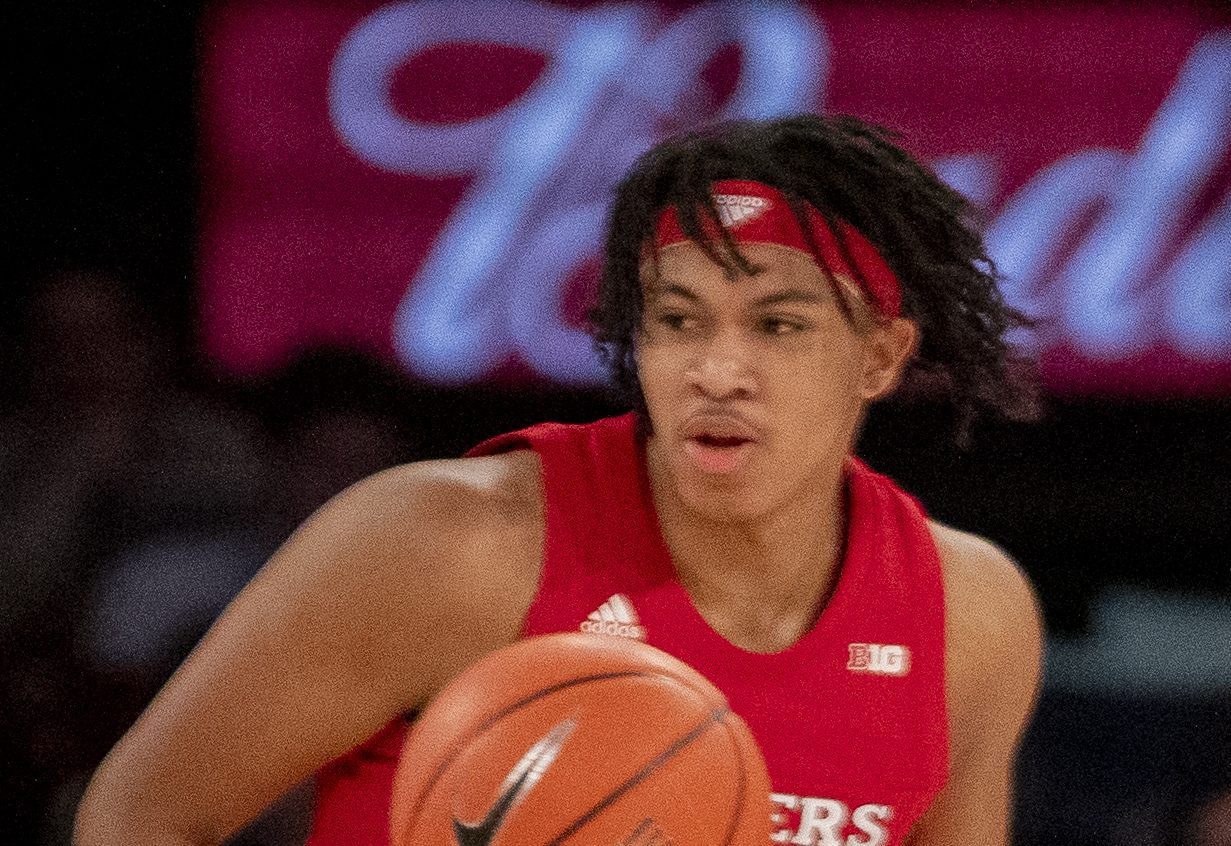
The family connection continued through his sons, Ron Harper Jr. and Dylan Harper. Both played college basketball at Rutgers, giving their father a familiar reason to be back in the stands. The shared name sometimes causes confusion, but the elder Harper’s playing career belongs to the Cavaliers, Clippers, Bulls and Lakers.
His Ohio roots have remained part of his public recognition, too. He entered the Ohio Basketball Hall of Fame in 2007 and the MAC Hall of Fame in 2023-honors that reach back beyond the championship years to the player Miami first put at the center of its team.
FAQ
How many NBA championships did Ron Harper win?
He won five: three with the Bulls in 1996, 1997 and 1998, and two with the Lakers in 2000 and 2001.
Which NBA teams did he play for?
He played for the Cleveland Cavaliers, Los Angeles Clippers, Chicago Bulls and Los Angeles Lakers from 1986 to 2001.
Where did he play college basketball?
He attended Miami University in Ohio from 1982 to 1986. The school retired his No. 34.
Was he ever an NBA All-Star?
No. Despite averaging more than 20 points in several seasons, Harper never received an NBA All-Star selection.
What jersey numbers did he wear?
He wore No. 4 with Cleveland, the Clippers and the Lakers, and No. 9 with Chicago.
Are Ron Harper Jr. and Dylan Harper his sons?
Yes. Both are his sons, and both played college basketball at Rutgers.
Photo: MGoBlog, CC BY-SA 2.0, via Wikimedia Commons