A torn Achilles, battered knees and years lost to politics never stopped Arvydas Sabonis from becoming one of basketball’s most unusual great centers. By the time he finally reached the NBA, Portland was getting a player in his 30s whose body had already absorbed a full career. What it still got was a 7-foot-3 playmaker from Kaunas who could pass like a guard, score on the block, rebound in traffic and see angles most big men never even look for.
From Kaunas prodigy to Soviet star
Arvydas Romas Sabonis was born on December 19, 1964, in Kaunas, then part of the Lithuanian SSR in the Soviet Union. He grew up in one of Europe’s true basketball cities, and his rise started early. Sabonis joined the Žalgiris Kaunas system as a teenager and was soon moving through Soviet youth basketball at unusual speed.
Those early years were shaped by more than talent alone. In the Soviet sports structure, basketball, state institutions and military obligations often overlapped. Sabonis reportedly enrolled at the Lithuanian University of Agriculture in part to avoid compulsory military service, a detail that has followed his story ever since.
By 1981, he was playing for Žalgiris at senior level. Around the same period, he also broke into the Soviet national team setup. He was still a teenager, but the outline of the player was already there: huge frame, soft hands, sharp passing instincts and a feel for the game that made him stand out even among elite prospects.
Žalgiris, titles and a growing reputation
The mid-1980s turned Sabonis from a prospect into one of the central figures in European basketball. With Žalgiris Kaunas, he helped win three straight USSR League titles in 1985, 1986 and 1987. The club also won the FIBA Intercontinental Cup in 1986.
His individual honors piled up quickly. He was named Euroscar European Player of the Year in 1984 and 1985, Mr. Europa in 1985, and Lithuanian Sportsman of the Year three straight times from 1984 through 1986. At EuroBasket 1985, he was named tournament MVP after leading the Soviet Union to gold.
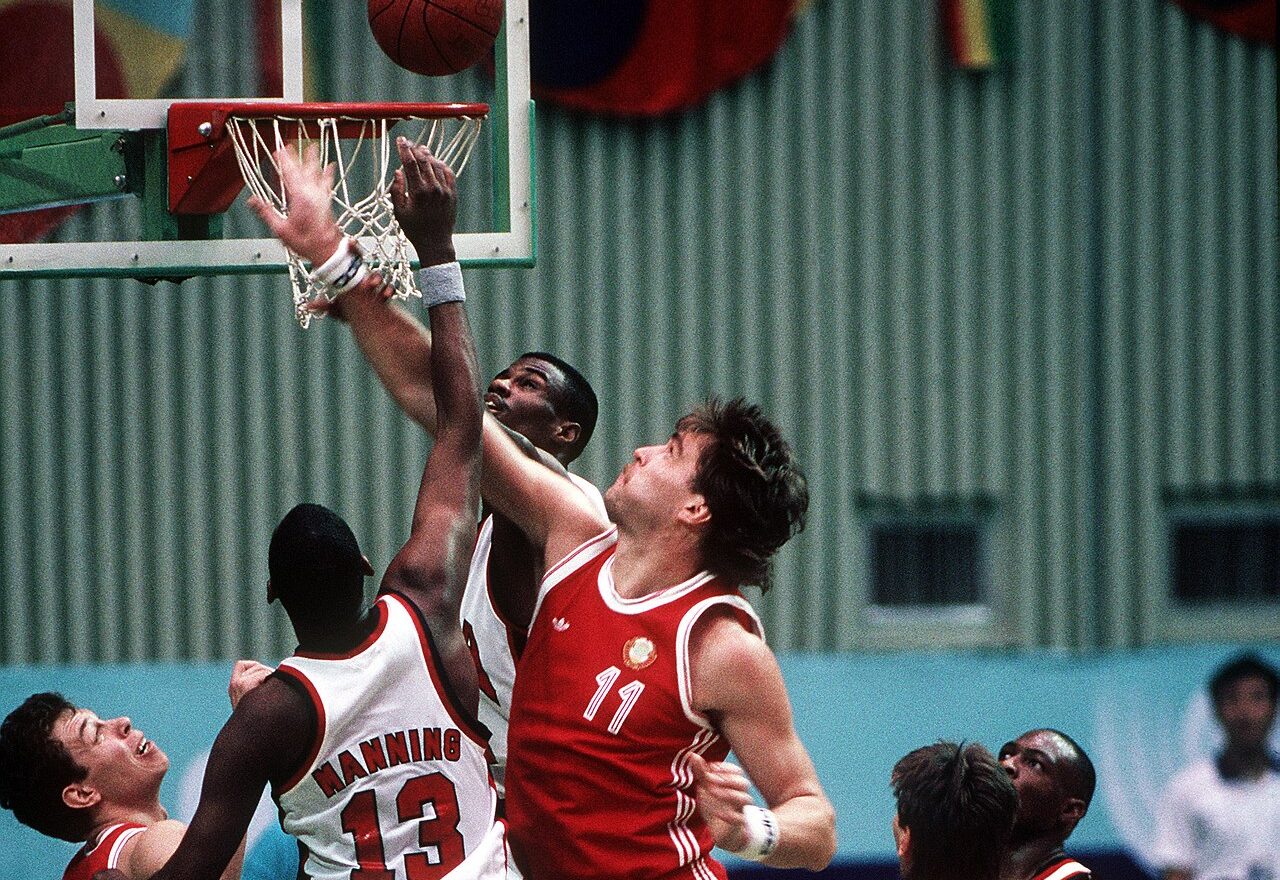
Internationally, his résumé from that period is loaded. Sabonis won gold at the 1982 FIBA World Championship, bronze at EuroBasket 1983, gold at EuroBasket 1985, silver at the 1986 FIBA World Championship, Olympic gold in 1988 and bronze at EuroBasket 1989. The Olympic title in Seoul remains one of the major landmarks of his career, with the Soviet team beating the United States in the semifinals on the way to gold.
Even then, the NBA had already noticed him. The Atlanta Hawks selected Sabonis in the 1985 NBA Draft, 77th overall, but the pick was voided because he was not yet eligible under the league’s age rules. A year later, the Portland Trail Blazers took him 24th overall in the first round of the 1986 NBA Draft.
That should have been the bridge to the league. It was not. Cold War restrictions kept him from leaving immediately, and injury soon complicated matters further.
The injury that changed the timeline
In 1986, Sabonis suffered a serious Achilles tendon injury, one of the defining setbacks of his career. He returned, and remarkably he returned well enough to play a major role in the 1988 Olympics, but the injury became part of the larger Sabonis story: how much of his peak the wider basketball world never fully saw.
That question has followed him for decades. What would the NBA version have looked like if he had arrived in his early 20s, before the surgeries and before so much mileage had built up? It is impossible to answer cleanly, but the question exists for a reason.
Spain: Valladolid, Real Madrid and another peak
Before Portland ever got him, Spain did. Sabonis played for Fórum Valladolid from 1989 to 1992, then moved to Real Madrid from 1992 to 1995. Those seasons mattered. They were not a holding pattern before the NBA; they were a major chapter of his career.
At Real Madrid, he added more top-level club success. He won the Copa del Rey in 1993, helped the club win the Liga ACB title in 1993 and 1994, and then led Real Madrid to the 1995 EuroLeague title. He was named Final Four MVP in that run.
His standing in the game was already secure by then, but Spain broadened it. Sabonis was no longer simply a Soviet or Lithuanian star known to specialists. He was a fully international basketball figure, admired for a style that looked strikingly modern: outlet passes fired the length of the floor, touch from mid-range, occasional three-point shooting, and the ability to run offense through the center spot.
Lithuania’s new era
After the breakup of the Soviet Union, Sabonis became one of the faces of independent Lithuanian basketball. That shift gave his international career a different emotional weight.
He led Lithuania to bronze at the 1992 Olympics in Barcelona, silver at EuroBasket 1995 and another Olympic bronze in 1996. He also played at EuroBasket 1999. For Lithuanian basketball, those medals were more than tournament results. They marked the return of a national team identity on one of sport’s biggest stages.
His individual recognition continued too. He won Euroscar again in 1995, 1997 and 1999, was named Mr. Europa again in 1997, and earned another Lithuanian Sportsman of the Year award in 1996.
Portland at last
When Sabonis finally joined the Portland Trail Blazers in 1995, he was already 30 and already famous. In one sense, that made his NBA arrival late. In another, it made it fascinating. The league was getting a player with a complete basketball education and a body held together by experience, treatment and stubbornness.
He made an immediate impression in the 1995-96 season and was selected to the NBA All-Rookie First Team. Across seven NBA seasons, all with Portland, he played 470 regular-season games and averaged 12.0 points, 7.3 rebounds and 2.1 assists.
The raw numbers only sketch the picture. Sabonis gave Portland size, passing and structure. He could score with either hand, hit cutters from the high post and punish switches on the block. He was also a strong positional rebounder and a smart rim protector, even after injuries had reduced his mobility. Long before the modern game celebrated playmaking centers, he was doing many of those things already.
His physical condition became part of his NBA legend. Trail Blazers team doctor Robert Cook once said Sabonis could qualify for a disabled parking permit “based on the X-ray alone.” The line stuck because it captured the contradiction. He looked worn down, and he was worn down, yet he remained highly effective.
Portland came close to a Finals trip during his years there, most notably in the 1999-2000 season, when the Blazers reached the Western Conference finals before losing to the Los Angeles Lakers in seven games. Sabonis was no longer the explosive young force Europe had seen in the 1980s, but he was still central to winning basketball.
Back to Žalgiris, and one last flourish
Sabonis left Portland after the 2000-01 season and returned to Žalgiris for 2001-02. He then came back to the Trail Blazers for one final NBA season in 2002-03 before finishing his playing career with Žalgiris in 2003-04.
That final stretch in Kaunas was more than a farewell tour. In 2003-04, he won the Lithuanian league title and was named EuroLeague Regular Season MVP. He also made the All-EuroLeague First Team and led the competition in rebounds and blocks while topping the league in Performance Index Rating.
For a player deep into his 30s, after decades of heavy minutes and major injuries, it was a remarkable closing act. Sabonis retired from professional basketball after that season.
How Arvydas Sabonis played
The easiest label is center, but it does not fully cover what made him special. Arvydas Sabonis was a low-post scorer, rebounder and shot-blocker, yes, but he was also one of the best passing big men the sport had seen.
He could throw touch passes over the top of a defense, start the break with one-handed outlets and operate as a hub from the elbow or the post. He had enough shooting range to stretch a defense and enough feel to slow a game down to his preferred tempo. In a later era, he would have fit neatly into the language of “floor-spacing” and “playmaking five.” In his own time, he simply looked unusual.
That is why his influence has lasted. Many of the traits now praised in modern skilled centers were visible in his game decades earlier.
Hall of Fame recognition and place in history
Sabonis entered the FIBA Hall of Fame in 2010 and the Naismith Memorial Basketball Hall of Fame in 2011. He was also named one of the 50 Greatest EuroLeague Contributors in 2008.
Any discussion of the best European players ever tends to include him, and usually near the top. Not because of mythology, but because the record is there: club titles in multiple countries, Olympic gold, medals with two different national setups, major individual awards across two decades, and a style of play that still feels fresh on old footage.
Off the court: family, business and public life
Away from basketball, Sabonis has long been a prominent public figure in Lithuania. He is married to Ingrida Mikelionytė, a former beauty pageant winner and model. They have four children: Aušrinė, Domantas, Tautvydas and Žygimantas. The best-known sports connection, of course, is Domantas Sabonis, who followed him into the NBA.
Business has been part of his post-playing life, though some claims around that portfolio are described differently depending on the source. Sabonis has been publicly linked to ventures in real estate, hospitality and sports-related business. Reports have also connected him to restaurant and fitness projects. Claims that he co-founded Lietuvos rytas are not accurate; he did not co-found the club.
He has also served in basketball administration. Sabonis was elected president of the Lithuanian Basketball Federation in 2011, stepping into a formal leadership role in the sport back home.
One of the most widely reported moments from his later public life came in 2011, when he suffered what news reports described as a mild heart attack. Afterward, he was quoted joking in his usual dry style about the restrictions doctors had given him. The line endured because it sounded very much like him: blunt, darkly funny and unwilling to lean into sentiment.
FAQ
When was Arvydas Sabonis born?
He was born on December 19, 1964.
What NBA team did Arvydas Sabonis play for?
He played all seven of his NBA seasons with the Portland Trail Blazers.
Did Arvydas Sabonis win Olympic gold?
Yes. He won gold with the Soviet Union at the 1988 Seoul Olympics.
Is Domantas Sabonis related to Arvydas Sabonis?
Yes. Domantas Sabonis is his son.
How tall was Arvydas Sabonis?
He was listed at 7 ft 3 in (2.21 m).
What made Arvydas Sabonis different as a center?
His passing, court vision and shooting touch set him apart, along with his scoring, rebounding and rim protection.
Photo: Ken Hackman, U.S. Air Force, Public domain, via Wikimedia Commons